
Client
Issues
The client faced margin pressure due to fluctuating crude palm oil prices, rising labor costs, and increasing ESG compliance requirements from export markets. Operational inefficiencies across logistics, refining processes, and downstream packaging were impacting profitability. There was also limited visibility into value leakage across different stages of the supply chain, making it difficult to prioritize investment decisions.
Solution
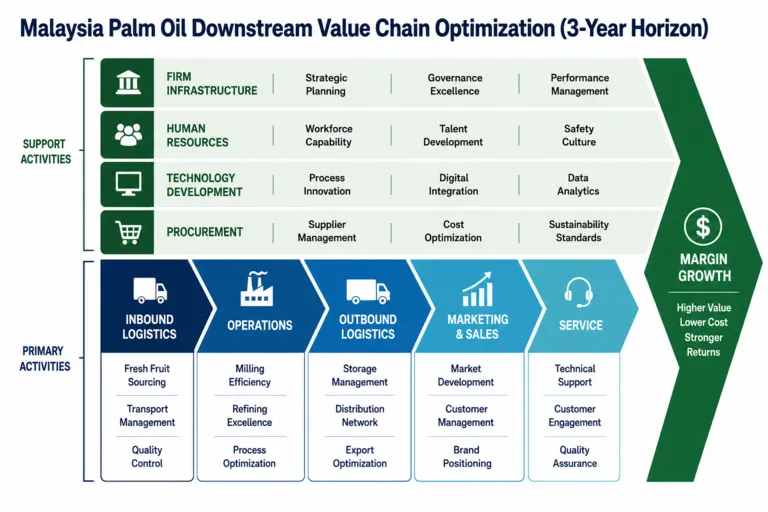
Eurogroup Consulting conducted a comprehensive value chain analysis covering upstream production, midstream processing, downstream manufacturing, distribution, and export channels to identify cost optimization and value capture opportunities.
Approach
Our team mapped the entire palm oil value chain from plantation harvesting to finished consumer products, analyzing cost structures, operational performance metrics, and margin distribution across each stage. We evaluated production yields, refining efficiency ratios, and logistics costs to identify bottlenecks and inefficiencies. Sustainability compliance requirements from key export markets were reviewed to assess certification gaps and potential premium pricing opportunities. Benchmarking against leading regional producers was conducted to determine competitiveness across productivity and cost indicators. Financial modeling was applied to simulate margin improvements under different operational enhancement scenarios.
Recommendations
We recommended investing in automation within refining facilities to improve yield efficiency and reduce labor dependency. Consolidation of logistics routes and improved warehouse coordination were advised to lower transportation costs. Strengthening sustainability certification processes was recommended to secure access to premium export markets. The client was also encouraged to expand higher-margin downstream consumer product lines to reduce exposure to raw commodity price volatility.
Engagement ROI
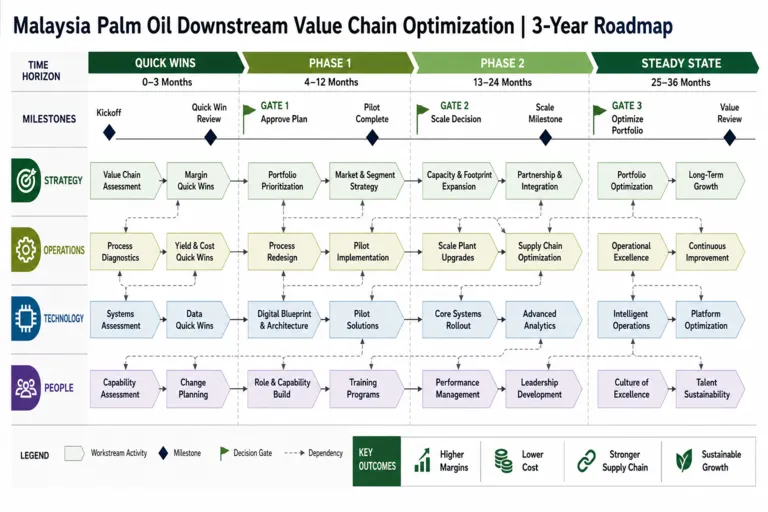
The value chain optimization roadmap identified potential cost savings of 10–15% across logistics and refining operations. Automation investments were projected to increase processing efficiency by 12%. Enhanced downstream diversification improved margin stability, reducing commodity price exposure by approximately 20%. Overall EBITDA improvement was estimated at 18% over a three-year horizon.