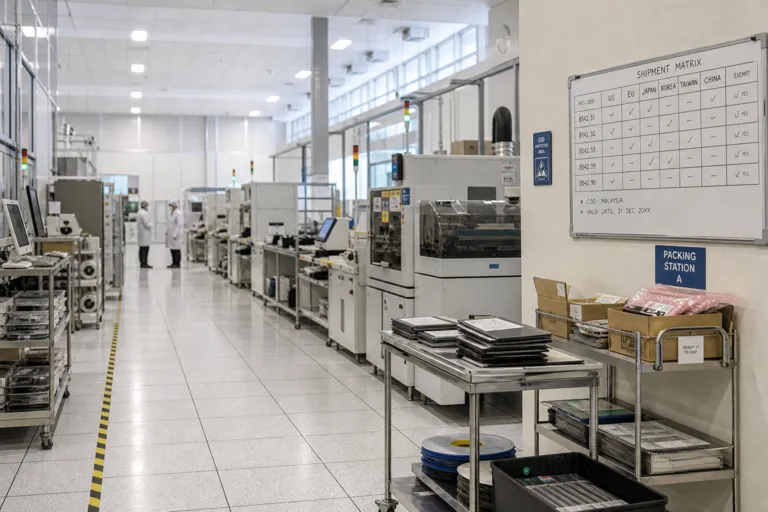
US tariff policy in 2026 creates two separate issues for Malaysian semiconductor supply chains. One is a country-level tariff “stack” that has shifted during the year. The other is a product-specific Section 232 action that targets a narrow class of advanced computing chips. Malaysia sits at the center of this story because its dominant export sector is semiconductor packaging, testing, and assembly, including concentrated back-end operations in the Penang manufacturing corridor, often called the “Silicon Valley of Asia.” Malaysia is also the eighth-largest US import source, and the US imported approximately $57 billion in goods from Malaysia in 2024. In that export profile, semiconductor and electronic components account for approximately 55% of total export value, which is why any chip-specific action can have outsized consequences.
In 2026, the baseline tariff picture on Malaysian-origin shipments has been volatile. An Executive Order in April 2025 announced a 24% reciprocal rate on Malaysian goods under an IEEPA “Liberation Day” framework, later reduced to a 10% baseline during a pause. Separately, a July 2026 tariff summary notes that the Supreme Court struck down the 2025 IEEPA tariffs in a 6–3 decision, and that Malaysia’s rate dropped from 24% to 10% Section 122, effective Feb. 24 and scheduled to sunset around July 24, 2026. That same source states that most semiconductors and electronic components enter at 0% MFN duty under the Information Technology Agreement, so the effective burden for the dominant chip category is described as 10% on the Section 122 layer. This shifting baseline matters to back-end packaging because it directly affects landed cost for packaged ICs and other Chapter 85 electronics entering the US.
What Section 232 Targets, and Why “Back-End” Still Cares
The Section 232 semiconductor tariff is different from broad country tariffs. Under Proclamation 11002 issued on Jan. 14, 2026, it imposes a 25% ad valorem duty effective Jan. 15, 2026 on certain advanced computing chips imported into the United States. It is described as “surgically scoped,” covering only chips that meet defined Tensor Processing Performance and DRAM bandwidth thresholds, with examples including the NVIDIA H200 and AMD MI325X. Sources also emphasize broad exemptions for US data centers, startups, R&D operations, and public sector applications, meaning many end uses may carve out of the duty if properly documented. For Malaysia’s back-end industry, the operational impact is often a classification-and-documentation problem: determining whether a packaged chip or a derivative assembly meets the technical thresholds, whether an exemption applies, and how to support an end-use claim that can survive CBP scrutiny.
Trade figures show why Malaysia remains a key reference point even as sourcing shifts. In US semiconductor imports, Malaysia supplied $21.5 billion worth of chips in 2021, the largest single source at that time. By 2025, Malaysia’s figure had fallen to $11.2 billion, a decline of about 48%, while Taiwan grew from $6.0 billion in 2021 to $13.6 billion in 2025 to become the top source. On the export side, Malaysia was also one of the largest markets for US-shipped semiconductors in 2025 at $7.9 billion, alongside Mexico ($13.2 billion), China ($10.7 billion), and Taiwan ($7.8 billion). In the first five months of 2026, US semiconductor imports rose 29% year-over-year to $24.3 billion while exports rose 15% to $28.1 billion, and the trade surplus narrowed to $3.8 billion from $5.6 billion in the same period of 2025, despite Section 232 tariffs coming into effect. Those US-wide numbers set the backdrop for the Malaysia semiconductor tariff 2026 conversation because they signal active trade flows during the new policy regime.
For Malaysia’s back-end packaging and testing ecosystem, the practical takeaway is that “tariff exposure” is no longer a single number. Many chips entering the US may face a 10% baseline layer as described in July 2026, while a narrower set of advanced chips may also trigger the Section 232 25% duty depending on technical thresholds and exemption eligibility. This matters because, as one analysis of semiconductor trade explains, much of the $40 billion of chips the US imports are actually made in the US, packaged abroad, and reimported, and the US lacks packaging capacity. Malaysia hosts packaging facilities for firms such as Intel and Texas Instruments, and Malaysia also hosts major operations for Intel, Infineon, and Texas Instruments that export directly to US buyers. In that context, the most defensible strategy is process-driven: map which product lines could fall under the covered parameters, separate end uses that qualify for carve-outs, and ensure entry documentation aligns with the claimed treatment.
What is the US Section 232 semiconductor tariff rate in 2026?
Does Section 232 apply to all chips shipped from Malaysia to the United States?
How did Malaysia’s chip exports to the US change between 2021 and 2025?
What changed in the 2026 US tariff baseline affecting Malaysian shipments?
What does the Malaysia semiconductor tariff 2026 issue mean for back-end packaging and testing firms?