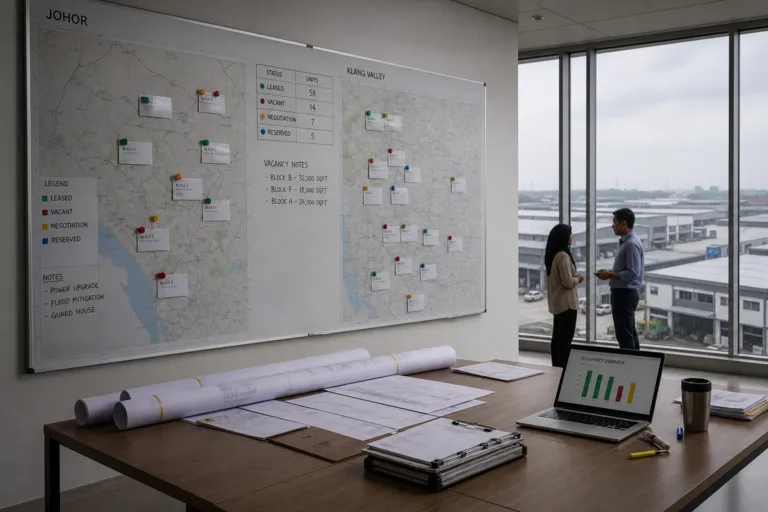
Malaysia industrial warehouse demand is being shaped by two engines that often move in parallel: the Klang Valley’s established industrial ecosystem and Johor’s fast-rising cross-border and infrastructure-led appeal. In 2026, multiple sources describe sustained demand tied to logistics, digital infrastructure, and manufacturing activity, alongside the practical realities of where large, functional sites can still be secured. Cushman & Wakefield notes that, despite steady completions of new industrial developments across Malaysia, high-quality and well-located warehouses and manufacturing facilities continue to see strong demand and rapid absorption. The same update adds that, in key hubs such as the Klang Valley, Johor, and Penang, prime logistics vacancy has remained low, and medium-to-large built-to-suit and ESG-compliant facilities are particularly scarce.
In the Klang Valley, the investment story is also about what is selling, not just how much is selling. The Edge Malaysia, citing CBRE | WTW’s Industrial Property Monitor (1Q2026), reports that in 2025 the transaction value of Malaysia’s industrial property market rose 21.3% year on year to RM33.8 billion, while transaction volume increased a more modest 1.4% to 8,910 units. CBRE | WTW interprets this divergence as a preference for higher-value industrial assets, supported by sustained demand from logistics and advanced manufacturing. For occupiers, that shift matters because it signals competition for quality space. For owners and developers, it highlights why specifications, access, and tenant requirements can become decisive in pricing and absorption.
Johor vs Klang Valley: What’s Driving Demand Where
The Klang Valley remains Malaysia’s core industrial region, and its scale is clear in the same CBRE | WTW monitoring: the Klang Valley industrial sector spans about 54,300ha of industrial-zoned land across key districts. The report also notes an uneven distribution that creates a “spatial hierarchy” across the region. It highlights steady expansion in the semi-detached factory segment, supported by established SMEs and owner-occupiers seeking larger and more efficient operational spaces, particularly among logistics-related businesses as well as light industrial and service-oriented users. This fits with broader commentary that demand is not only from large corporates, but also from SMEs that prioritise operational efficiency, connectivity, and workable building formats.
Johor’s demand narrative leans more heavily on spillover and positioning. A Johor-focused market note describes proximity to Singapore, strong connectivity via Senai Airport, Port of Tanjung Pelepas (PTP), and major highways, and ongoing government support under Iskandar Malaysia and industrial development policies. It also points to a “data centre boom” and rising needs for land with high power supply. The same source names Senai, Nusajaya/Iskandar Puteri, Pasir Gudang, and Kulai as key industrial areas, each aligned to logistics, multinational activity, established port-linked heavy industry, or larger land availability. The overall investment comparison presented is that Johor draws attention for lower entry price per sq ft, larger land availability, and growing demand from Singapore-based businesses, especially for those priced out of Selangor industrial markets.
Cross-border investment signals add another layer to Johor’s pipeline. A Johor-Singapore SEZ comparison article states that Singapore was Malaysia’s largest foreign investor, with Singapore companies pouring in RM22.6 billion of FDI in 2023. It links that investor base to a strong pipeline of demand for Johor sites, implying factories and warehouses in the Johor-Singapore SEZ are likely to see high occupancy and rental yields. Separately, a national investment outlook summary frames 2026 demand as connected to global supply-chain realignment, booming e-commerce, data centres and high-tech/advanced manufacturing, infrastructure upgrades, and supportive policies and investment flows. Taken together, these points explain why occupiers weigh Johor’s availability and cross-border logic against the Klang Valley’s depth, scale, and established industrial hierarchy when deciding where to expand.
What is driving industrial warehouse demand in Johor and the Klang Valley?
What do 2025 industrial transaction figures suggest about Malaysia’s market direction?
How large is the Klang Valley industrial land footprint mentioned in market monitoring?
Why does Johor get compared with the Klang Valley for industrial site selection?
How does the Malaysia industrial warehouse demand topic connect to Singapore investment flows?