Malaysia’s semiconductor story starts with scale in assembly, test, and packaging. Multiple sources put the country at about 13% of global chip assembly, test, and packaging output, and one also notes Malaysia OSATs ship 13% of global chips, mostly through multinational corporation (MNC) facilities located in the country. That base matters because it anchors supply chains, talent, and manufacturing discipline. But it also exposes a gap. Presentations cited in reporting state that advanced packaging techniques sit in MNC facilities, while local companies “don’t have any.” Malaysia’s next step is therefore not just more output, but deeper process know-how and higher-value activities.
The push into advanced packaging is being framed as urgent because AI infrastructure depends on it. One report describes advanced packaging as the integration step that combines multiple chips—memory, logic, and compute—into a single high-performing unit. It also cites a global market worth around US$51.6 billion in 2025, forecast to nearly double by 2031. Another source projects the advanced packaging market will grow at a 26% compound annual growth rate to reach US$80 billion by 2030, and adds that advanced techniques can command up to 50% gross margins, compared with sub-20% margins for traditional OSAT work such as wire bonding. That margin spread is a direct incentive for Malaysia to move upward.
From MNC-Led Capability to Local Process Ownership
Malaysia’s local players are now organizing to close the capability gap. At SEMICON Southeast Asia 2026, five Malaysian companies—Inari Amertron, Pentamaster, NSW Automation, SkyeChip, and startup FusionAP—formally launched the Malaysia Advanced Packaging Consortium (MAPC), with an MOU signed in the presence of government leadership. Their stated target is to capture 7% of the global advanced packaging market by 2035, a position one source describes as starting from “zero” for local capability. A separate interview quoted a view that Malaysia is “probably about 10%” in advanced packaging when counting what multinationals already do on Malaysian soil, underscoring the distinction between national footprint and local ownership of process knowledge.
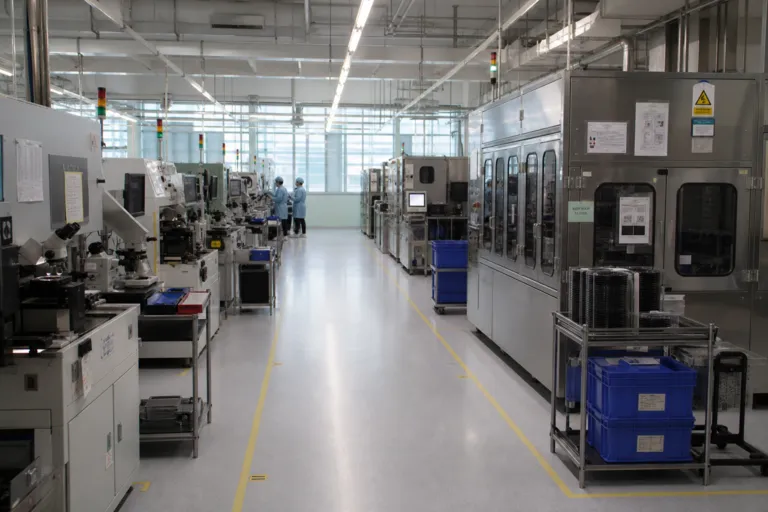
Moving up the value chain also requires front-end progress, not only better back-end packaging. A foundry market report values Malaysia’s semiconductor foundry market at USD 0.83 billion in 2025 and forecasts USD 1.3 billion by 2030, expanding at a 9.5% CAGR. It links momentum to “China-plus-one” diversification, a decade-long RM 25 billion (USD 5.33 billion) National Semiconductor Strategy, and over USD 25 billion of data-center and chip investments announced between 2021 and 2023. The same report states average fab utilization is above 85% in 2025, and that 28 nm processes led with 30.6% share in 2024, while 10/7/5 nm nodes are projected at a 15.2% CAGR to 2030. These figures show why front-end capability is becoming part of Malaysia’s climb.
Execution will hinge on infrastructure, ecosystem depth, and speed. A Malaysia-focused report stresses that front-end wafer fabrication and advanced packaging facilities need reliable power, ultra-pure water, tightly controlled environments, and infrastructure that meets demanding standards. It warns that standalone fab announcements can fail without a mature, interconnected ecosystem. Meanwhile, the competitive clock is ticking. One source notes Nvidia is releasing a new AI chip product every twelve months, compressing suppliers’ reaction windows and raising the cost of mistakes. Another highlights that advanced packaging is concentrated in Taiwan, and that co-packaged photonics is emerging as a new frontier. In this context, Malaysia advanced chip packaging becomes a race to translate today’s 13% assembly base into locally owned, higher-value capability.
What is Malaysia’s current role in global chip assembly, test, and packaging?
How big is the advanced packaging market, according to the sources?
What target has Malaysia set for locally driven advanced packaging by 2035?
What does the foundry data say about Malaysia’s front-end growth outlook?
What are the key requirements for scaling advanced packaging and front-end fabs in Malaysia?