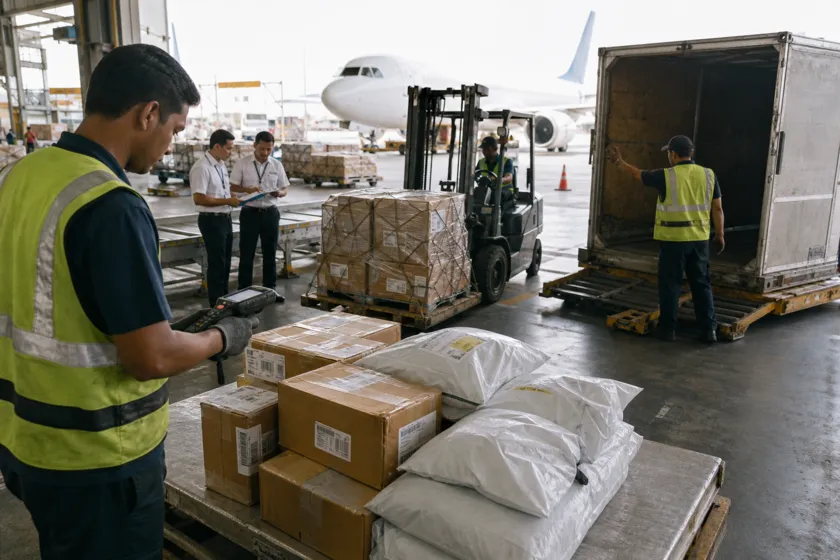
Air cargo is moving from a supporting role to a headline growth story in Malaysia’s logistics landscape. In Mordor Intelligence’s view of the sector, air freight is poised to be the fastest-growing freight transport mode, forecast to expand at a 6.50% CAGR during 2026–2031. That outpaces the overall Malaysia freight and logistics market growth of 5.14% CAGR over the same period, where the market is expected to grow from USD 29.70 billion in 2025 to USD 31.23 billion in 2026, reaching USD 40.11 billion by 2031. For shippers, the appeal is simple: air freight fits high-value and time-sensitive cargo, and it supports faster cross-border movement when speed is the deciding factor.
Several demand-side forces are feeding that shift. E-commerce is a central one. Market Research Future reports that e-commerce sales in Malaysia reached approximately MYR 50 billion in 2025, and it links that expansion to rising requirements for efficient delivery solutions and faster operations. Mordor Intelligence also highlights how consumer expectations are reshaping networks, noting that same-day fulfillment has become a standard expectation, with leading platforms shipping 95% of orders within 24 hours. While last-mile is not the same as air cargo, these service expectations ripple upstream into replenishment cycles, inventory positioning, and the need for reliable uplift for urgent and cross-border shipments.
Why Air Freight Is Winning Share in a Multi-Mode Market
Air’s growth is also tied to how Malaysia’s logistics market is structured and where trade friction is being removed. In 2025, freight transport held 55.62% of the Malaysia freight and logistics market share, while road freight services led by mode with a 50.94% share. That makes air a smaller base today, but a faster climber tomorrow. On the forwarding side, sea and inland waterways freight forwarding generated 74.10% of revenue in 2025, yet air freight forwarding is projected to record a 5.81% CAGR between 2026 and 2031. Regional trade agreements are another tailwind: Market Research Future points to Malaysia’s participation in the Regional Comprehensive Economic Partnership (RCEP), which is expected to facilitate easier access to Asia-Pacific markets and increase the volume of goods transported.
Investment and modernization trends support the operational side of that growth story. Market Research Future estimates that logistics companies in Malaysia will invest over MYR 1 billion in technology in 2025, citing tools such as artificial intelligence, big data analytics, and the Internet of Things for better tracking and optimization. At the same time, foreign direct investment reached MYR 378.5 billion (USD 82.3 billion) in 2024, creating 207,000 jobs, according to Mordor Intelligence, which links this to expanding demand for cross-border forwarding and specialized manufacturing logistics. Market-specific infrastructure signals also matter. MarkWide Research notes that international airports such as Kuala Lumpur International Airport (KLIA) contribute to air segment growth by enabling international connectivity.
For decision-makers tracking the Malaysia Air Freight Market as a planning priority, the clearest takeaway is that growth is being pulled by speed requirements, not by one single industry alone. Manufacturing represented 38.98% of the market in 2025, and wholesale and retail trade is projected to grow at a 5.46% CAGR during 2026–2031, according to Mordor Intelligence. These end-users tend to value predictable lead times, shipment visibility, and dependable capacity for urgent orders. Over the same horizon, the market is also navigating sustainability expectations: Market Research Future projects that demand for sustainable logistics solutions will increase by 20% in 2025, encouraging providers to rethink routing, packaging, and fleet choices while they expand faster services.
What is driving growth in Malaysia’s air freight segment?
How fast is air freight expected to grow compared with the overall logistics market?
What role does e-commerce play in air cargo demand in Malaysia?
How does air freight forwarding compare with sea freight forwarding in Malaysia?
What should companies watch in the Malaysia Air Freight Market through 2031?