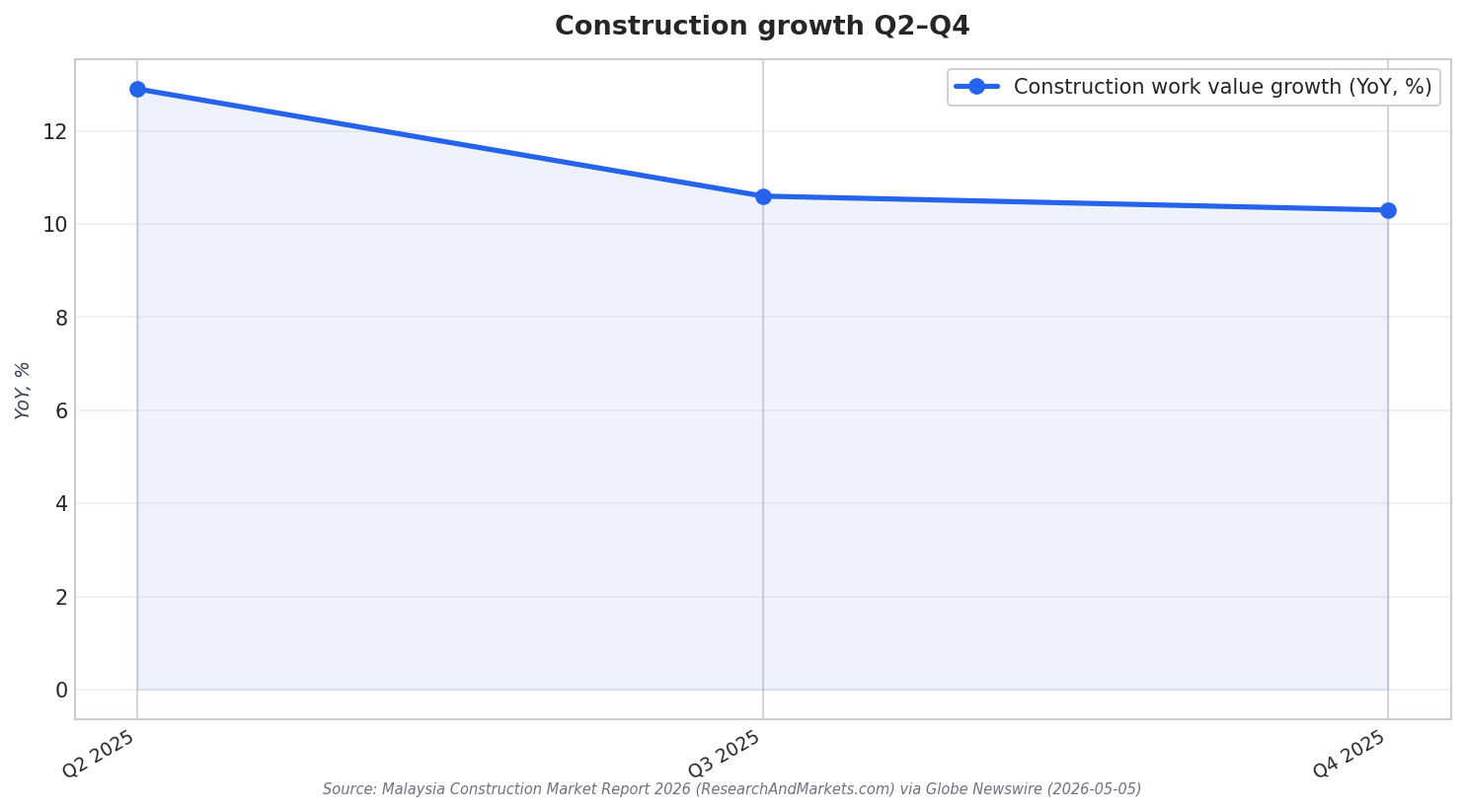
Malaysia’s construction pipeline is increasingly defined by industrial and digital projects. ResearchAndMarkets.com projects the Malaysian construction industry will expand by 6.5% in real terms by 2026, supported by investments in transport infrastructure and allocations within Malaysia’s 2026 Budget. That budget, approved in October 2025, earmarks MYR470 billion (USD 105.9 billion) in total spending, with significant portions devoted to Government-Linked Investment Companies (GLICs) initiatives. At the same time, Department of Statistics Malaysia (DOSM) data shows the total value of construction work rose 10.3% year on year in Q4 2025, following 10.6% in Q3 2025 and 12.9% in Q2 2025. Within Q4 2025, non-residential construction grew 18.6% YoY, highlighting momentum in the kinds of assets needed for modern manufacturing and data infrastructure.
One clear driver of the Malaysia Industrial Construction Boom is industrial upgrading under the New Industrial Master Plan 2030 (NIMP 2030). The plan targets an increase in the manufacturing sector’s GDP from MYR364.9 billion (USD 82.2 billion) in 2022 to MYR587.5 billion (USD 132.4 billion) by 2030. A key initiative is the upgrade of 3,000 factories into smart factories by 2030, which is associated with an estimated MYR5 billion (USD 1.1 billion) investment. For contractors and consultants, this points to sustained demand not only for new builds, but also for retrofits that can support automation-ready layouts and modern plant utilities. ResearchAndMarkets.com also expects the industry, post-2026, to average 3.5% annual growth through 2030, driven by industrial, transport, and energy sector investments.
Data Centres Are Rewriting the Industrial Build Playbook
Data centre construction is adding a second engine to industrial construction activity, especially around Johor and Cyberjaya. Mordor Intelligence estimates the Malaysia data center construction market reached USD 3.71 billion in 2026 and is projected to reach USD 7.74 billion by 2031, at a 15.88% CAGR. The same source links growth to hyperscale spill-over from Singapore and a 10-year tax holiday for qualifying builds, alongside added connectivity from the 2024 MIST, Apricot, and Bifrost cable landings. It also notes that at least 12 global and regional providers announced greenfield or expansion projects worth more than USD 15 billion since 2024. Market structure is also described in detail: Tier 3 facilities held 56.04% of the data centre construction market share in 2025, large facilities held 55.46%, and colocation held 56.28%.
Broader market tracking reinforces how fast the digital build-out is moving. Mordor Intelligence values the Malaysia data center market at USD 5.48 billion in 2025 and estimates growth from USD 6.55 billion in 2026 to USD 16.02 billion by 2031, a 19.55% CAGR. It also projects IT load capacity will rise from 1.53 GW to 6.43 GW over the same period, described as a 33.24% CAGR, and notes hyperscaler commitments of MYR90.2 billion (USD 20.3 billion). Hotspot concentration is material for site strategy: Johor Bahru accounted for 53.20% of market size in 2025, while Cyberjaya is forecast to post a 29.60% CAGR through 2031. In parallel, Arizton estimates the Malaysia data center market was USD 6.15 billion in 2025 and expects it to reach USD 11.40 billion by 2031, while stating around 700 MW is under construction and a further 3.3 GW is planned or announced.
Energy and infrastructure programs are also shaping how industrial sites and campuses get planned and delivered. ResearchAndMarkets.com highlights the Southern Johor Renewable Energy Corridor (SJREC), announced in December 2025, with MYR26.6 billion (USD 6 billion) in funding from the World Bank. The project includes a 2,000 km hybrid solar and battery energy storage system zone connecting Southeast Asia, and by 2030 the initial phase is expected to achieve up to 4 GWp of solar capacity and 5.12 GWh of energy storage. Separately, Market Research Future projects the Malaysia Construction Market will grow at a 6.0% CAGR from 2025 to 2035 and points to greater adoption of BIM, prefabrication techniques, and smart technologies such as IoT and AI to streamline construction processes. Together, these signals suggest Malaysia’s industrial expansion will increasingly blend factory upgrades, data centre specialization, and energy-linked enabling works.
What is driving Malaysia’s industrial construction surge?
How fast is Malaysia’s data centre construction market growing?
Which Malaysian locations are most important for data centre growth?
What do recent construction statistics say about momentum in Malaysia?
How does the Malaysia Industrial Construction Boom connect to energy and infrastructure projects?