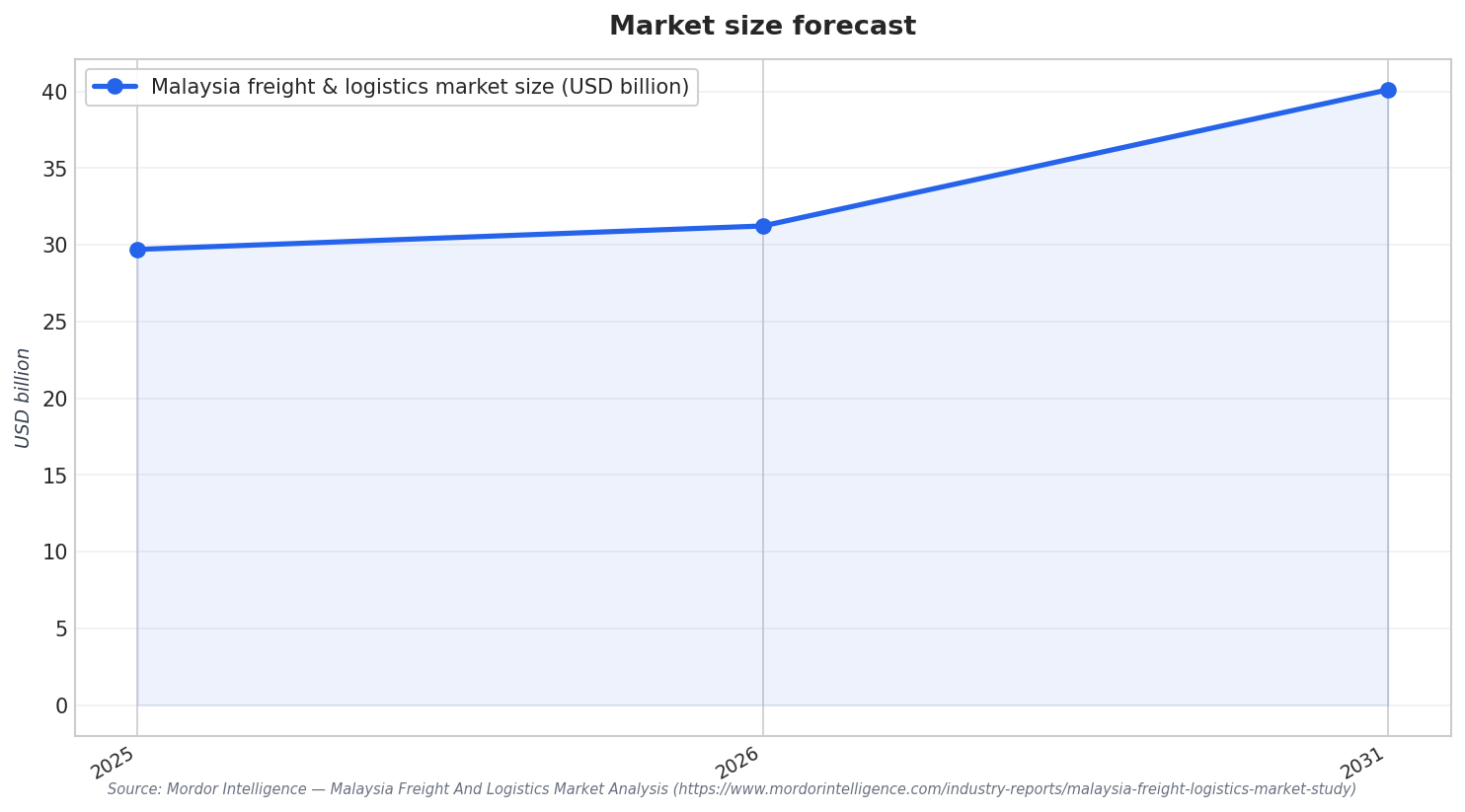
The Malaysia Freight Logistics Market outlook to 2031 points to sustained expansion. Mordor Intelligence expects the market to grow from USD 29.70 billion in 2025 to USD 31.23 billion in 2026, and to reach USD 40.11 billion by 2031. The same forecast indicates a 5.14% CAGR over 2026–2031. Growth is framed around shifting supply-chain networks, changing warehouse priorities, and evolving carrier partnerships, as Malaysia strengthens its role within ASEAN and wider Asia-Pacific trade flows.
Multiple demand engines are layered on top of this baseline. Foreign direct investment reached MYR 378.5 billion (USD 82.3 billion) in 2024, creating 207,000 jobs, and expanding demand for cross-border forwarding, value-added distribution, and specialized manufacturing logistics. Port Klang is cited as the world’s 10th-busiest container port, reinforcing Malaysia’s role as a regional trade gateway. At the same time, regulatory moves such as targeted diesel subsidies and simplified customs windows are described as easing cost pressures and reducing border friction.
What’s Driving Growth Across Modes and Services
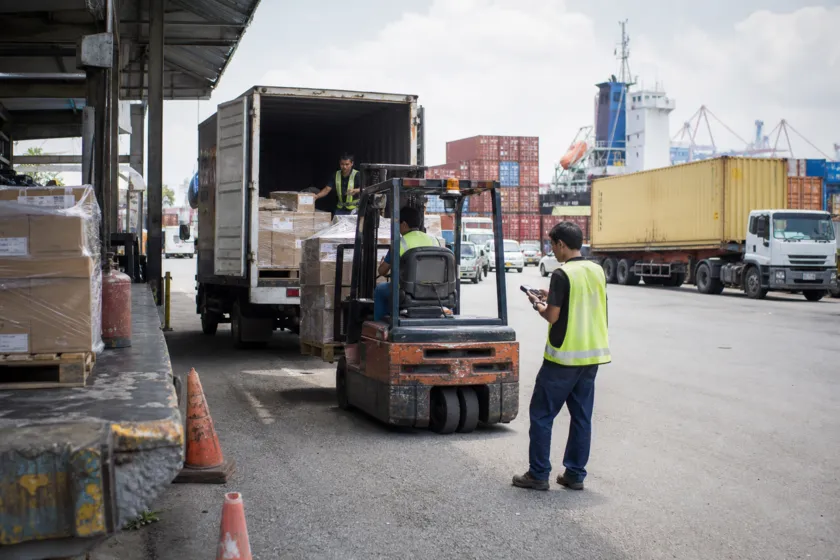
Market structure helps explain where momentum is concentrating. In 2025, freight transport represented 55.62% of market share by logistics function. Road freight services led by mode with a 50.94% share in 2025, while sea and inland waterways freight forwarding generated 74.10% of freight forwarding revenue that year. Yet faster-growth pockets stand out in the forecasts: air freight is poised for a 6.50% CAGR over 2026–2031, while air freight forwarding is projected at a 5.81% CAGR over the same period. These projections align with carrier efforts to secure air-cargo uplift and temperature-controlled capacity.
E-commerce and service expectations are also reshaping network design. Same-day fulfillment is described as a standard expectation, with leading platforms shipping 95% of orders within 24 hours. The sources add that 64.8% of internet users lean toward free delivery, which pressures providers to optimize routes, densify last-mile coverage, and pursue automation. Courier, express, and parcel services are forecast to expand at a 5.86% CAGR between 2026 and 2031. Within CEP, domestic deliveries held an 84.23% share in 2025, while international CEP is forecast to grow at a 6.51% CAGR between 2026 and 2031, reflecting SME export expansion.
Industry and facility needs point to additional upside through 2031. Manufacturing accounted for 38.98% of the market size in 2025, and wholesale and retail trade is on track for a 5.46% CAGR between 2026 and 2031. Warehousing demand is also shifting in mix: non-temperature controlled space dominated with a 91.10% share in 2025, while temperature-controlled capacity is predicted to rise at a 6.24% CAGR between 2026 and 2031, tied in the sources to pharmaceutical and halal-food needs. For road-specific context, Mordor Intelligence forecasts Malaysia’s road freight transport market to grow from USD 8.60 billion in 2025 to USD 9.02 billion in 2026 and reach USD 11.47 billion by 2031, a 4.93% CAGR over 2026–2031.
How large is Malaysia’s freight and logistics market expected to be by 2031?
What CAGR is forecast for the Malaysia Freight Logistics Market through 2031?
Which transport modes and forwarding segments are growing fastest in the outlook?
What do the sources say about last-mile delivery expectations in Malaysia?
Why is temperature-controlled warehousing expected to expand faster than general storage?