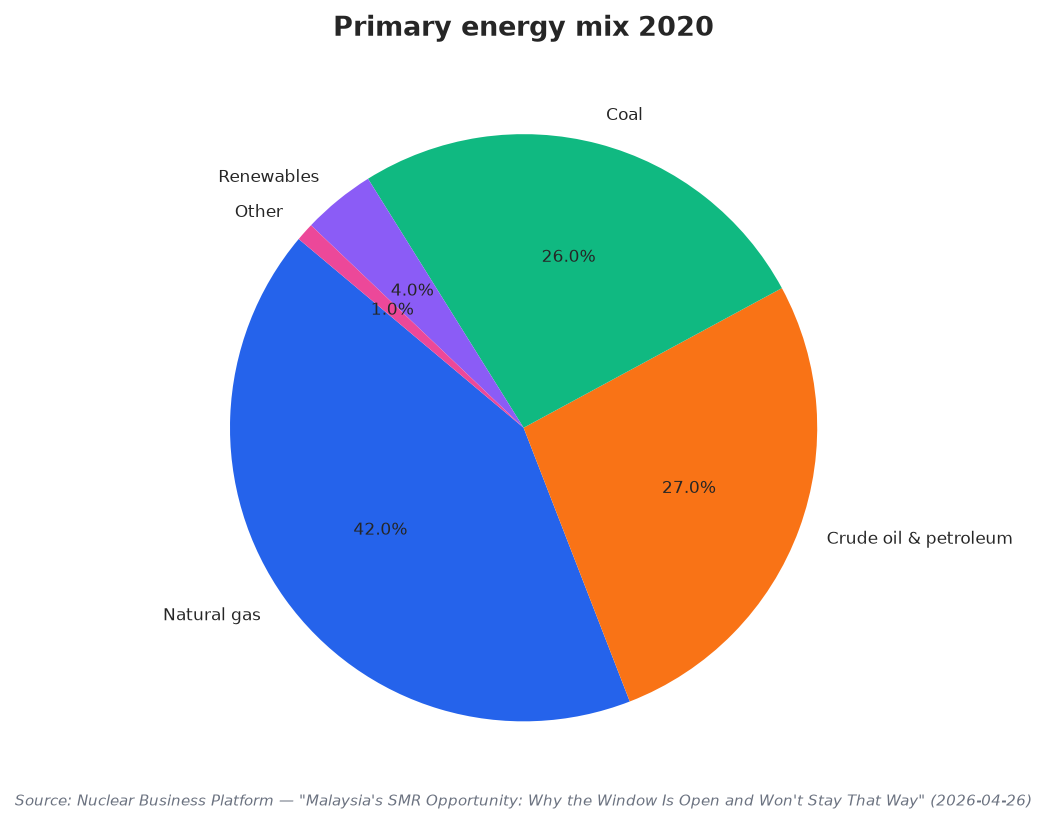
Malaysia is studying nuclear energy to strengthen long-term energy security, and the initiative is aligned with the 13th Malaysia Plan (13MP) tabled on July 31, 2025. The policy context is shaped by energy-market volatility tied to global tensions and disruptions to key routes such as the Strait of Hormuz. Separately, Malaysia has committed to carbon neutrality by 2050 and has set a target of 70% renewables in its power generation mix by 2050. Yet its starting point is heavily fossil-based: as recently as 2020, fossil fuels accounted for over 96% of Malaysia’s primary energy, with natural gas at 42%, crude oil and petroleum at 27%, and coal at 26%, while renewables were under 4%.
Against that gap, small modular reactors (SMRs) have moved to the foreground of Malaysia’s nuclear discussions. Since September 2024, the government has expressed interest in reviving nuclear ambitions to meet decarbonisation goals under the New Energy Transition Roadmap (NETR), with SMRs highlighted. However, SMRs are described as not wholly commercially viable, with only a handful of greenlit projects globally. In the local debate, an associate professor of nuclear science and engineering at Universiti Kebangsaan Malaysia argues SMRs can support Malaysia’s future energy mix by providing continuous baseload electricity and grid stability, particularly when used to complement renewables and address intermittency from sources such as solar.
What the 2035 Target Implies for Permitting, Grid Fit, and Scale
Malaysia’s timeline signals both intent and complexity. A commentary notes the Cabinet approved a 2035 nuclear power deployment target in 2024, and in December 2025 the government amended the nuclear regulatory framework by mandating permits for the import, export, and transshipment of radioactive materials. The same analysis says Malaysia must ratify at least eight international conventions and protocols before any deployment, and that regulatory milestones alone will reportedly take 10 years. It also frames build time realities: from the decision-making stage to deployment, large nuclear power plants could take 12 to 15 years, while SMRs are still relatively nascent and are expected to be proven in the next decade.
On capacity and plant-sizing logic, industry voices highlight modularity as a practical advantage for a mid-sized grid. One local SMR design-company executive says SMRs are estimated to produce 300 MW on average, with some designs such as the British Rolls-Royce producing 450 MW. For comparison, a typical large conventional reactor is cited at around 1,400 MW (1.4 GW), implying it would take about four SMRs to match one conventional unit. The same discussion argues that, because the technology generates high-pressure steam to spin a turbine, current fossil fuel plants can be converted into SMRs, and some designs could integrate into existing coal plant infrastructure to accelerate deployment and commissioning.
For investors, the near-term signal is not only feasibility language but whether Malaysia can move from studies to bankable milestones. A nuclear-industry insight piece says Malaysia is targeting 1.2 GW of SMR capacity by 2035, with that deadline revised from an earlier 2031 target due to regulatory challenges, while stating that Economy Minister Rafizi Ramli and Natural Resources Minister Nik Nazmi Nik Ahmad have indicated nuclear is back on the agenda. It also cites regional context from Wood Mackenzie: Southeast Asia will require approximately US$208 billion in investment to develop 25 GW of nuclear capacity by 2050, with SMRs emerging as the preferred technology across the region. Investors should also track demand narratives linked to energy-intensive growth, including data centres, and assess market risks: a global investing note warns that SMR investments can be sensitive to market corrections and re-ratings tied to the broader AI investment boom.
How does the 13th Malaysia Plan (13MP) connect to nuclear energy studies?
What SMR capacity target has been discussed for Malaysia, and when?
What does Malaysia’s energy mix baseline look like in the sources?
How do SMR unit sizes compare with a conventional large reactor in the sources?
What should investors watch in the Malaysia nuclear energy SMR story?