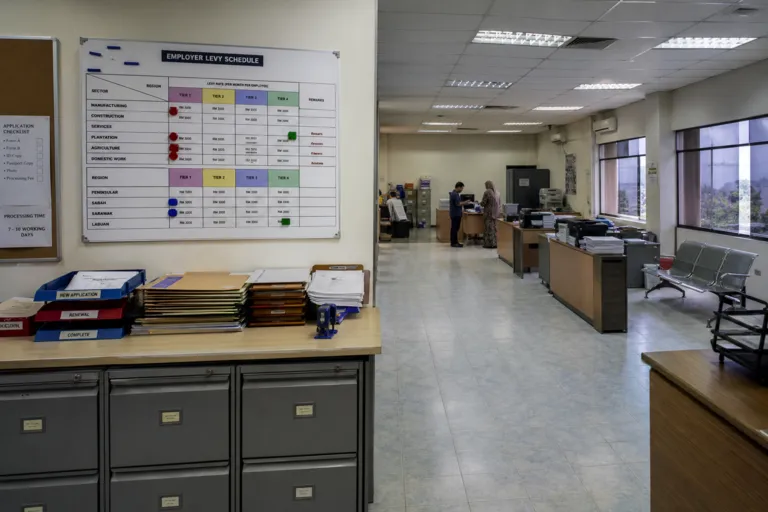
Cost planning for foreign labour in Malaysia starts with one recurring line item: the foreign worker levy. It is an annual charge paid by the employer to the government for each foreign worker holding a valid Visit Pass (Temporary Employment), VP(TE), under the PLKS regime. The levy sits on top of wages and recurs each year the worker stays. The obligation is the employer’s responsibility and is not a deduction from the worker’s wages. Because the levy is fixed by sector and region, two workers on different salaries can carry the same levy if they are in the same sector and state.
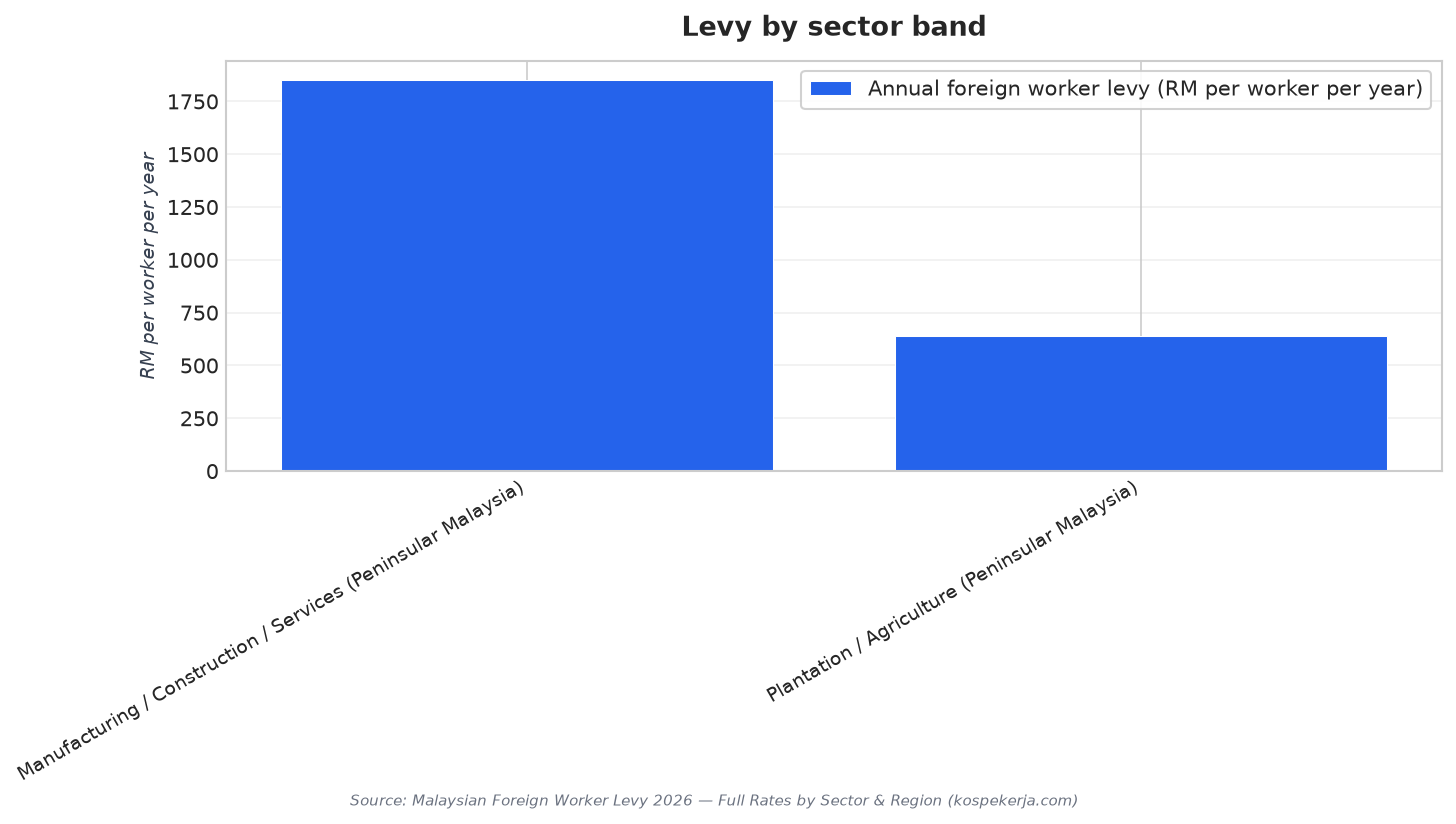
For Peninsular Malaysia, published rates for 2025–2026 put manufacturing, construction, services, and mining in the higher band at RM 1,850 per worker per year, while plantation and agriculture fall in the lower band at RM 640 per worker per year. Sabah and Sarawak are on lower schedules overall, described as RM410–RM1,490 depending on sector and region in one guide, and Sarawak also applies an additional RM 1,854 charge under its Foreign Workers Transformation Approach (FWTA) on top of the basic Sarawak levy. One source flags this Sarawak surcharge as provisional and recommends confirming it with an official Sarawak or Immigration reference before relying on it for final budgeting.
Multi-Tier Levy (MTLM): Build Scenarios, Not Assumptions
Employers planning the Malaysia foreign worker levy 2026 also need a strategy for change. Multiple sources note that a Multi-Tier Levy Model (MTLM) was delayed from 2025 and is due in 2026 under the 13th Malaysia Plan, and that it is expected to raise levies further for employers most reliant on foreign labour. At the time of the sources, the MTLM had not been gazetted. That means finance teams should avoid hard-coding a single “new” rate into forecasts. Instead, use today’s published sector-and-region levies as the base case and add a contingency scenario for higher levy exposure once the tiered model is finalized.
The levy is only the start of the recurring employment cost stack. Employers also need to layer on immigration and statutory costs. One guide notes a flat RM60 VP(TE) processing fee and RM125 visa processing fee charged by the Immigration Department of Malaysia (JIM), regardless of sector or region. Beyond immigration paperwork, employer EPF for non-citizen workers is mandatory at 2% of wages since October 2025, and employer SOCSO under First Category is 1.75% of wages (1.25% Employment Injury plus 0.5% Invalidity) for workers under 55 since 1 July 2024. Foreign workers are excluded from EIS, per one source.
Practical cost planning also means mapping the worker to the correct permit track and eligibility rules. Manual and semi-skilled foreign labour typically falls under PLKS rather than the Employment Pass used for expatriate professionals. Approved PLKS sectors include manufacturing, construction, plantation, agriculture, services, and mining and quarrying, and “services” is defined by specified sub-sectors rather than being open-ended. One guide also notes Malaysia accepts PLKS workers from a fixed list of roughly 15 approved source countries, and that not every country may supply every sector. Finally, keep an eye on the policy direction: one source reports Malaysia’s registered foreign workforce fell 13% to 2.13 million in the year to October 2025, as the government pushes toward cutting dependency to 10% of the workforce by 2030.
How much is the foreign worker levy in Peninsular Malaysia for 2025–2026?
Does the employer or the worker pay Malaysia’s foreign worker levy?
What is Sarawak’s FWTA surcharge and how does it affect budgeting?
What should employers expect from the Malaysia foreign worker levy 2026 and the MTLM?
What other recurring costs sit on top of the levy for foreign workers?