Malaysia’s Economy Ministry says the Johor-Singapore Special Economic Zone (JS-SEZ) remains “firmly on track” even though the launch of its master plan and investment blueprint was postponed. The two macro plans were initially slated for Mar 30, but the launch was delayed as authorities sought broader alignment across federal agencies. The ministry framed the master plan as a practical reference for investors and implementing agencies, and said implementation work has continued in parallel. According to Economy Minister Akmal Nasrullah Mohd Nasir, efforts have continued on investment facilitation, infrastructure, talent and energy ecosystems, customs and immigration processes, and cross-border connectivity.
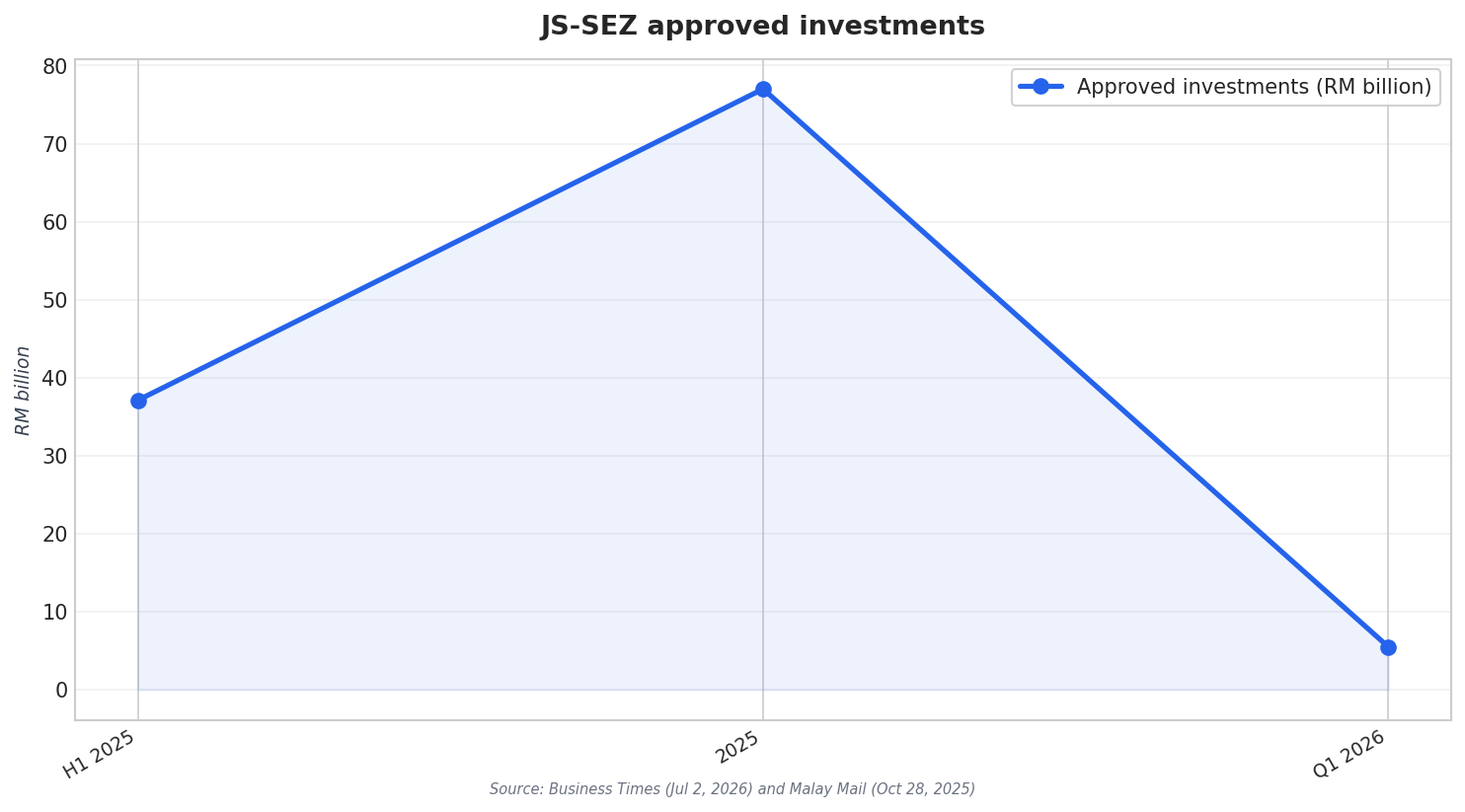
On investment activity, the ministry cited multiple data points that show the zone is moving beyond paper plans. The JS-SEZ secured around RM77 billion in approved investments in 2025, and 57% of cumulative approved investments have progressed to the implementation stage. It also recorded nearly RM5.5 billion in approved investments during the first quarter of 2026. From January to May 2026, the Invest Malaysia Facilitation Centre-Johor (IMFC-J) managed 285 investment enquiries with identified potential investments totalling RM74.1 billion. Taken together, these indicators suggest that investor interest has continued while policy coordination for the master plan proceeds.
What Investors Are Watching as the Master Plan Waits
Several sources highlight how the JS-SEZ is being positioned and what that could mean for Johor-Singapore SEZ Investment 2026 decisions. A government reply reported that total approved investments for the first half of 2025 in the JS-SEZ amounted to RM37.1 billion, and named the top three investing countries as Singapore (RM28.5 billion), Italy (RM2.9 billion), and China (RM700 million). The same reply said the study on the JS-SEZ action plan was expected to be completed in Q1 2026. It also said that as of September 30, IMFC-J had facilitated 808 enquiries from foreign and domestic investors, including 11 potential projects or investments worth RM1.3 billion through collaboration with the Economic Development Board (EDB) and Enterprise Singapore.
Singapore’s EDB highlighted business expansion interest tied to the JS-SEZ and described ongoing efforts to make it easier for companies to operate across borders. Deputy Prime Minister and Minister for Trade and Industry Gan Kim Yong said that since the signing of the JS-SEZ MOU in January 2024, Singapore-based companies have committed more than S$5.5 billion in investments into Johor. At the second JS-SEZ Joint Investment Forum in Singapore on 14 October 2025, the event drew more than 700 attendees, and both countries reaffirmed initiatives to develop talent, improve connectivity, and smoothen the flow of goods and people. Johor’s Chief Minister Onn Hafiz Ghazi also said Johor was “on track” to hitting approved investments of more than RM100 billion by end of the year.
Beyond official announcements, market-facing analyses describe how capital and sector focus are evolving. FactSet wrote that total deal value rose from $56.3 billion in 2024 to $57.5 billion in 2025 across Singapore, Johor, and the broader JS-SEZ corridor, even as overall deal volume fell, which it interpreted as larger, more strategic transactions. Another analysis said the JS-SEZ was established in January 2025, spans over 3,500 square kilometres, and includes nine flagship projects across 11 sectors. That same source cited Department of Statistics Malaysia data that Johor posted the highest growth rate in the country, bringing in MYR 158 billion in 2024, and said 60% of Southeast Asia’s data centres is concentrated in Johor. These are the kinds of signals investors may weigh as the master plan is coordinated for implementation readiness and policy alignment.
How much investment was approved in the JS-SEZ in 2025, and what happened in early 2026?
How much of approved JS-SEZ investment has moved into implementation?
What is the timeline for the JS-SEZ action plan study mentioned by the government?
Which countries were listed as the top investors in the JS-SEZ, based on government-reported figures?
What does the Johor-Singapore SEZ investment outlook for 2026 suggest about investor interest?