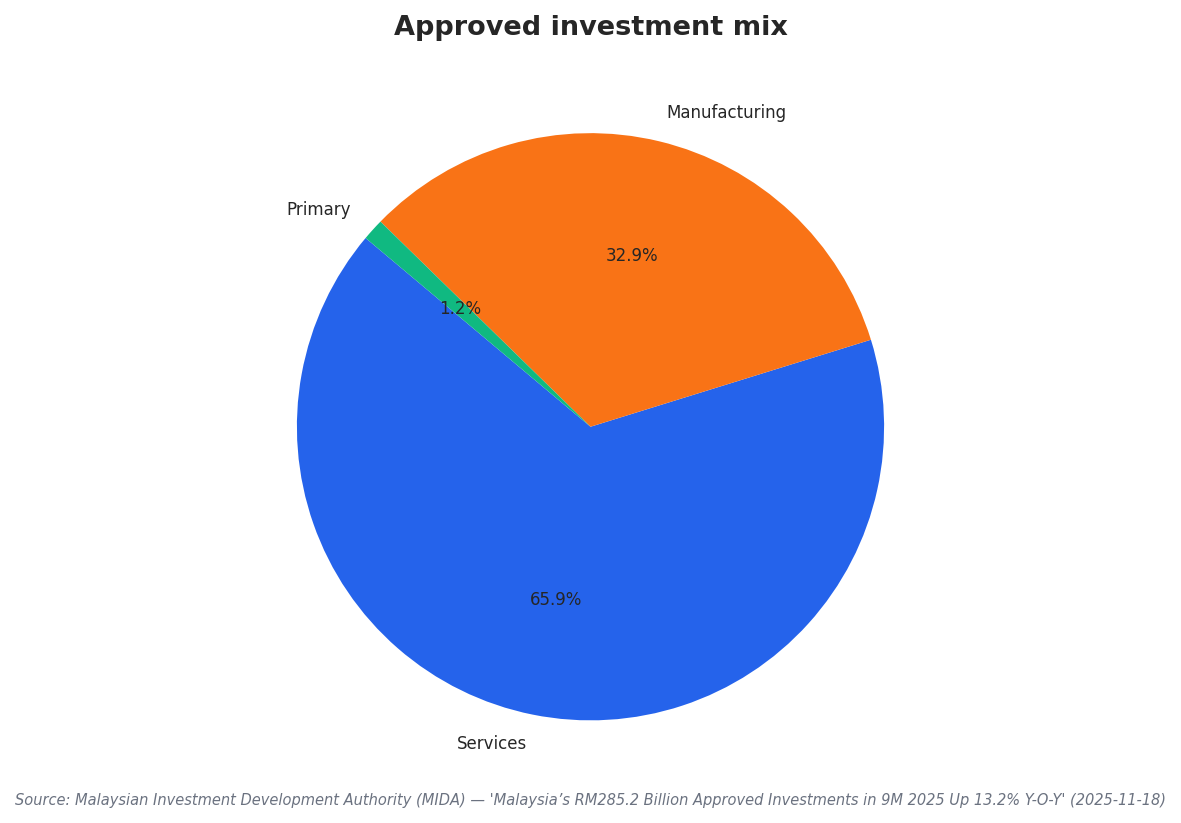
Malaysia’s investment pipeline is evolving fast, and manufacturing is one of the clearest drivers of how industrial zones are expanding and modernizing. In the first nine months of 2025, Malaysia recorded RM285.2 billion in approved investments, up 13.2% year-on-year, across 4,874 approved projects, with projected job creation of 152,766. Manufacturing approvals reached RM93.8 billion (32.9% of the total) and grew 5.6% year-on-year, while foreign investments accounted for 52.9% (RM150.8 billion) of the overall approved total. For industrial zones, this mix matters because it links land, utilities, and workforce planning to a higher share of export-oriented and multinational projects.
Foreign direct investment inflows also point to a stronger manufacturing-linked cycle, even when services pull in the biggest share of capital. A DOSM-reported update cited record FDI of 65.9 billion MYR in 2025, up 41.2% from 46.7 billion MYR in 2024, driven by stronger foreign equity investment and inflows into debt instruments. By end-2025, cumulative FDI stock was 1.087 trillion MYR, equal to 53.7% of GDP, versus 51.4% a year earlier. While the same source noted services as the main recipient of inflows, it also reported that manufacturing generated the highest FDI income at 55.5 billion MYR, reinforcing why factory-led clusters remain central to Malaysia’s industrial-zone narrative.
How Manufacturing Investment Is Rewiring Industrial Logistics
The logistics system around industrial zones is adjusting to the new profile of manufacturing projects, especially those requiring higher security and tighter quality controls. A freight and logistics market report projects the Malaysia freight and logistics market to expand from USD 29.70 billion in 2025 to USD 40.11 billion by 2031, at a CAGR of 5.14% (2026–2031). The same research cited foreign direct investment reaching MYR 378.5 billion (USD 82.3 billion) in 2024, creating 207,000 jobs, and linked semiconductor investments to demand for electrostatic-discharge-compliant packaging, bonded-warehouse clearance lanes, and secure robotics. It also noted Port Klang’s position as the world’s 10th-busiest container port, while warning of vessel waiting times averaging 1.3–1.46 days, a bottleneck industrial-zone planners cannot ignore.
Industrial zone reshaping is also geographic. In 9M 2025 approvals, Johor led all states with RM91.1 billion, followed by Selangor (RM51.9 billion), W.P. Kuala Lumpur (RM45.9 billion), Penang (RM23.7 billion), and Kedah (RM17.5 billion). Source-country patterns reinforce why certain corridors attract repeat capital: for the same 9M 2025 period, Singapore led foreign investment sources with RM52.7 billion, followed by China (RM35.8 billion), the United States (RM11.3 billion), the British Virgin Islands (RM6.6 billion), and Japan (RM4.8 billion). Together, these flows are shaping where suppliers cluster, where new factory shells get built, and where multi-tenant industrial parks gain pricing power.
For the Malaysia FDI Manufacturing Surge topic, the most practical takeaway is how cross-border zone design is shifting from land-only development to logistics-first ecosystems. The same freight and logistics research expects cross-border tax incentives inside the Johor-Singapore Special Economic Zone to add 100 projects and 20,000 skilled jobs. It also reported manufacturing held 38.98% of Malaysia’s freight and logistics market share in 2025, supported by Penang’s MY 431 billion (USD 93.7 billion) export engine and Selangor’s electronics clusters. In early 2026, FDI inflows remained “relatively solid,” with MYR 22.81 billion in Q1 2026 after MYR 26.64 billion in Q4, a reminder that industrial zones must be resilient even as quarterly inflows fluctuate.
How is Malaysia’s manufacturing-led investment changing industrial zones?
What headline FDI figures show momentum in Malaysia recently?
Which Malaysian states are leading approved investments tied to industrial expansion?
What does the Johor-Singapore Special Economic Zone signal for new projects?
What port and logistics constraints could affect industrial-zone performance?