Malaysia’s demographic transition is no longer a distant scenario. It is already shaping labour supply, healthcare demand, and long-term growth expectations, while changing buyer priorities years before the country officially becomes an aged nation. The Department of Statistics Malaysia (DOSM) shows fertility has been below the replacement level of 2.1 since 2013, and total fertility rate fell to 1.6 in 2022. This shift can create a domino effect, including fewer young workers entering the labour force, higher dependency ratios, and increased retirement-related financial pressure. It also makes family caregiving and retirement insecurity more visible social issues that consumers and employers cannot ignore.
Those pressures also signal why a Malaysia silver economy narrative is taking hold: older adults are becoming a bigger share of customers, patients, voters, and workers. CodeBlue reports that in Malaysia, older adults aged 50 and above are projected to grow from seven million (21% of the population) to 14 million (34% of the population) in under 20 years. The same source says Malaysia will officially become an ageing nation by 2030, and will become a super-ageing society within 35 years, like Japan. As this happens, demand rises for services tailored to later life, and the private sector has already begun responding in nursing homes, retirement communities, and home-care services.
Where Demand Concentrates: Care, Housing, Finance, and AgeTech
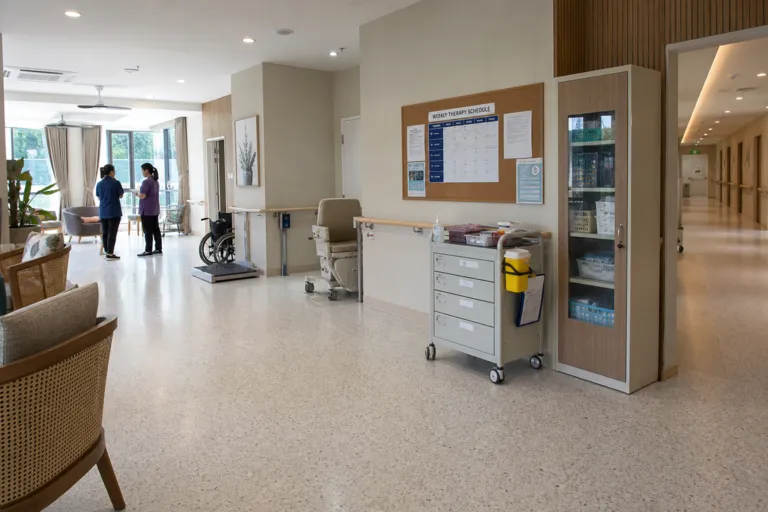
The silver economy is often grouped around practical, everyday needs. CodeBlue lists age-friendly housing, assisted living facilities, medical technologies, rehabilitation services, home-based care, financial planning for retirement, and travel or wellness services designed for older adults. It also points to AgeTech, including fall-detection devices, telehealth platforms, remote monitoring systems, and digital tools that help older adults live independently for longer. But expansion can be uneven if it develops in a policy vacuum, so the key question is whether policy guides market growth or simply reacts to it after gaps and abuses emerge.
Several signals show how Malaysia is starting to connect ageing to economic participation, not only costs. The Edge Malaysia cites DOSM Current Population Estimates 2025: the share of Malaysians aged 65 and above increased from 7.6% in 2024 to 8.0% in 2025, while the old-age dependency ratio rose from 10.9% to 11.4%. DOSM’s 1Q2026 demographic statistics again placed the 65-and-above population at 8.0%. The same article highlights retiree entrepreneurship as a practical income channel, aligned with the 13th Malaysia Plan, 2026-2030 (13MP), which identifies preparation for an aged nation as a national priority including labour participation, social protection, skills development, and long-term care.
Execution matters because older-age participation often happens through small businesses and services. DOSM’s Micro, Small and Medium Enterprises Performance 2024 report (as cited by The Edge Malaysia) states MSMEs contributed RM652.4 billion in value add, or 39.5% of gross domestic product, and employed 8.1 million people, equivalent to 48.7% of total employment. That structure can support retiree-led micro enterprises in services such as tutoring, repairs, care support, local tourism, and digital reselling. For comparison on the broader regional opportunity, Baker Tilly Singapore estimates the Asia-Pacific silver economy at US$4.6 trillion in 2025 (approximately S$6.2 trillion), and estimates Singapore’s silver economy at S$97.8 billion—useful context as Malaysia builds its own policy and business playbook.
What is driving Malaysia’s silver-economy opportunity?
How fast is Malaysia’s 50+ population expected to grow?
Which sectors are most linked to the Malaysia silver economy?
What do recent DOSM figures show about ageing and dependency?
Why are MSMEs important to building purchasing power among older Malaysians?