Managing Malaysia freight rates volatility in 2027 is not just a procurement issue. Ocean rates can shift quickly and ripple into capacity, budgets, and service quality across trade lanes, which is why treating volatility as “temporary” can be a systemic mistake. When rates spike, the damage is not limited to a higher freight bill. Rapid swings can create capacity constraints, unstable container space, and weaker schedule reliability. That operational uncertainty can push companies to raise safety-stock thresholds to protect manufacturing timelines and customer delivery windows, increasing total operating costs beyond transport.
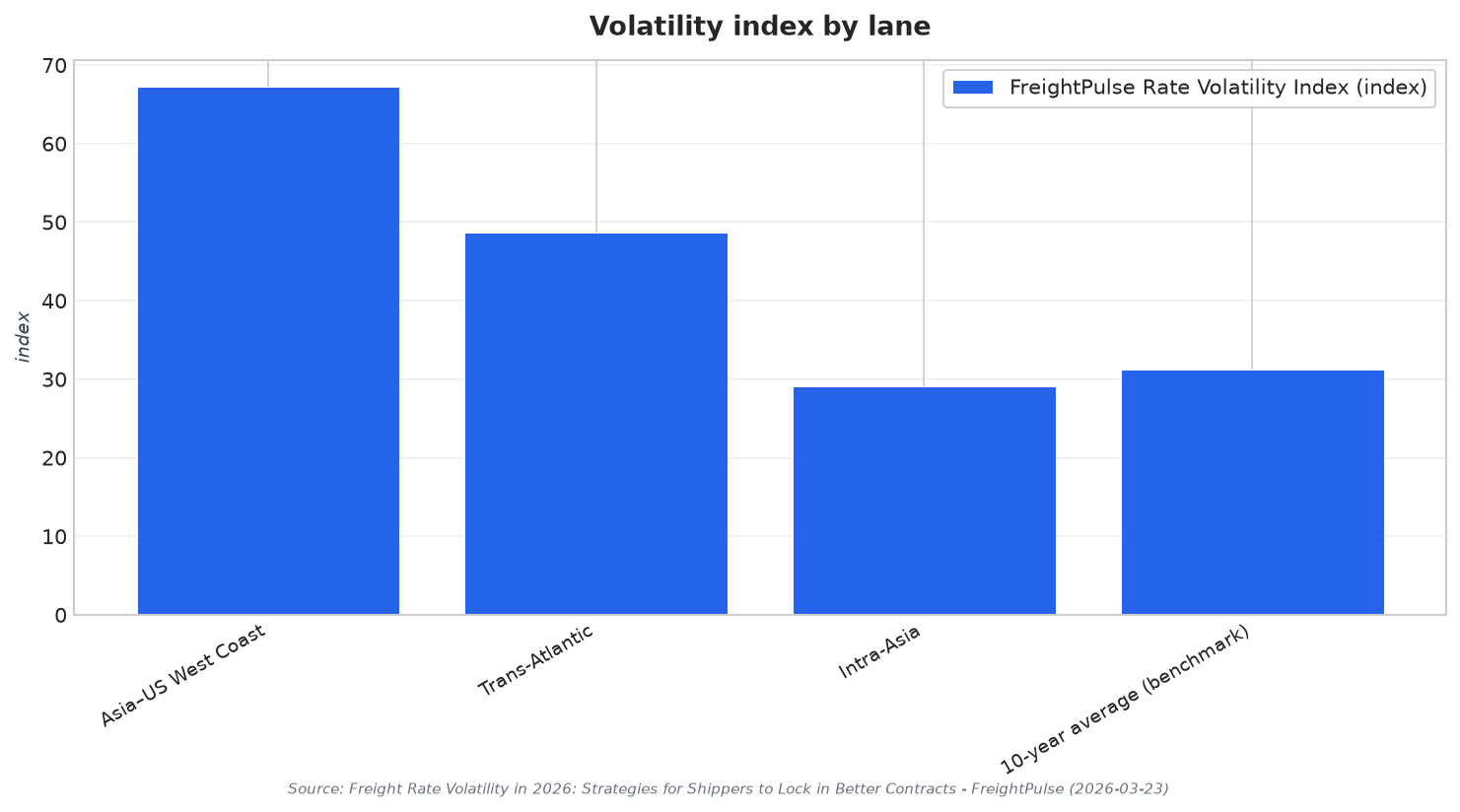
Shippers also need to understand how fast the market can move. FreightPulse noted that, across major trade lanes, rates can swing 40% in a single quarter, with surcharges that appear overnight. As context for global volatility, the Shanghai Containerized Freight Index (SCFI) fluctuated between 1,200 and 3,800 points from January 2025 onward. On the data side, FreightPulse’s Rate Volatility Index for Asia–US West Coast reached 67.3 in February 2026 versus a 10-year average of 31.2, while Trans-Atlantic was 48.7 and intra-Asia 29.1. These figures are not Malaysia-specific, but they show how large week-to-week variability can become in lanes that influence equipment and network behavior.
A 2027 Playbook: Blend Contracts, Build Flexibility, and Monitor Weekly
A practical approach is to build flexibility into the network itself. C.H. Robinson highlights using a broader mix of carriers, flexible contracts that adapt to shifts, and backup plans before disruptions happen, such as shifting to a different port, selecting an alternative ocean service, or moving time-sensitive cargo to air or ground when ocean lanes become unreliable. FreightPulse describes a blended contract model used by shippers in 2026: 60% fixed annual contracts, 25% index-linked contracts tied to published indices plus a spread, and 15% spot buying for opportunities when spot dips below contract levels. For governance, FreightPulse recommends weekly benchmarking, and Allied Group notes that spot rates may need weekly or even daily monitoring during volatile periods.
Malaysian shippers can also frame volatility around local structure and constraints. Sea and inland waterways forwarding generated 74.10% of Malaysia’s freight and logistics market revenue in 2025, reflecting the Strait of Malacca’s positioning and dense feeder services. Mordor Intelligence adds that rising blank sailings and schedule volatility have pushed forwarders to secure priority berthing contracts and install AI-enabled cargo-visibility dashboards. On domestic routes, Market Research Future reports that the Domestic Shipping Licensing Board limits peninsular–East Malaysia routes to Malaysian-flagged vessels, which restricts competition and keeps sea-freight rates 20–30% above comparable intra-ASEAN routes, with periodic exemptions easing costs only marginally.
Finally, plan for modal and execution options that can dampen risk. The 665 km East Coast Rail Link is reported as 78.5% complete, with Phase 1 slated to start in January 2027, and the 2027 launch is expected to shift bulk cargo from road to rail, diversifying options. Road execution can also improve through digital freight matching: platforms such as Lorryz and TheLorry have demonstrated that real-time load optimization can reduce empty backhaul trips by up to 25%. Across the same theme, Allied Group argues that the advantage is not predicting every move. It is seeing changes earlier, measuring the impact, and responding consistently, because volatility cannot be eliminated but the financial impact can be controlled.
How can Malaysian shippers manage freight-rate volatility in 2027 without guessing the market?
What blended contract mix are shippers using to reduce rate exposure?
Which Malaysia-specific factors can keep sea freight expensive on some domestic corridors?
What local signals suggest Malaysia is investing in options beyond road-only freight?
How often should shippers monitor rates in volatile periods?