Malaysia’s debate over vaping is no longer just about personal choice. It is increasingly about lung health, enforcement, and how quickly rules can change. Adult smoking remains widespread. Malaysia has about 4.9 million current smokers, or 17.9% of the adult population, with a wide gender gap: 33.6% of men are current smokers versus 0.5% of women. Tobacco smoking is linked to 24,106 deaths annually in Malaysia, according to the Global State of Tobacco Harm Reduction (GSTHR) profile. At the same time, vaping has expanded. Official estimates cited in Malaysia reporting place adult e-cigarette use at 5.8%, roughly 1.4 million people. GSTHR also reports 5.8% adult vaping prevalence in 2023, estimated at about 1.5 million vapers.
Policy is moving alongside the market. E-cigarettes are allowed, but with restrictions. People cannot purchase e-cigarettes through online channels or vending machines, and there are restrictions on vaping in public places. The minimum legal age is 18 years. Manufacturers must notify authorities before introducing new products. There are no restrictions on flavours, but nicotine content must not exceed 20 mg/ml. Heated tobacco products (HTPs) are also legally allowed, with similar limits on online or vending machine sales, health warnings on packaging, public-place restrictions, and the same minimum legal age of 18. These rules frame what Malaysia’s regulators can tighten without an outright ban.
Excise Windfall vs Public Health Pressure
Excise collections help explain why enforcement and health policy are colliding. Between 2021 and July 2025, excise duties on smoking products in Malaysia added up to RM15.3 billion (US$3.6 billion). Over the same period, total tax revenue collected from devices, nicotine, and non-nicotine liquids or gels used in electronic cigarettes and vapes amounted to RM288.5 million, only 1.9% of the total tax revenue collected. The excise regime has been evolving. Initially, excise duty was imposed on non-nicotine liquid or gel used in e-cigarettes at RM0.40 per millilitre. An April 2023 Finance Ministry announcement imposed an excise duty of RM0.40 per millilitre beginning April 1, and described the Malaysian vape market as worth more than RM2 billion.
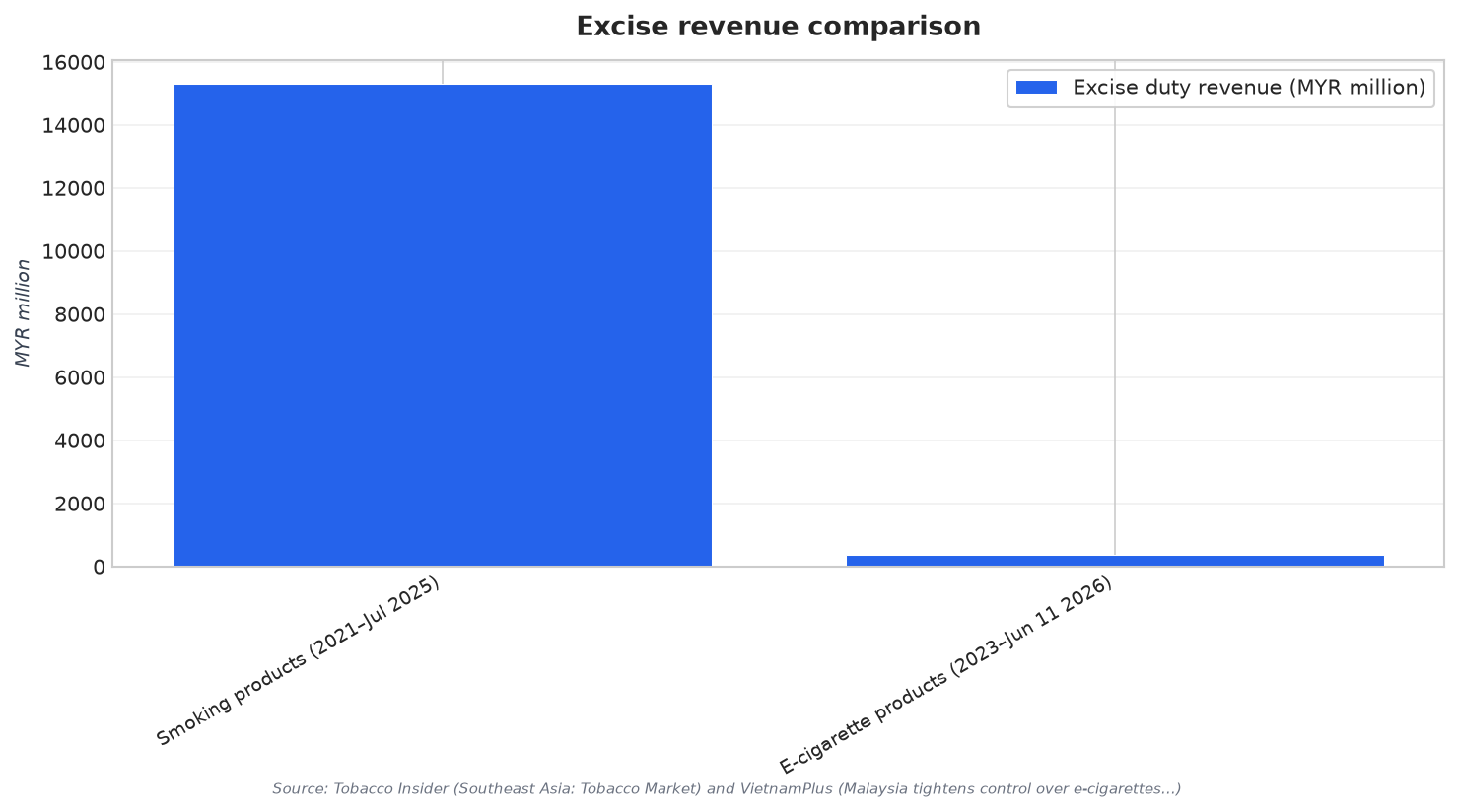
In 2026, the health argument is being sharpened with cost claims and product-risk concerns. Malaysia’s Ministry of Health (MOH) said the health and economic costs associated with vaping-related illnesses significantly outweigh the 354.51 million MYR in excise duty collected from e-cigarette products between 2023 and June 11, 2026. In the same reporting, the annual healthcare and economic burden linked to vaping-related diseases was estimated at 369 million MYR (about 90 million USD). The MOH said it is tightening oversight of high-risk vaping products and is considering a proposal to ban bottled e-cigarette liquids, citing the risk that they can be mixed with drugs and other prohibited substances. Separately, the Health Ministry proposed raising the excise duty on vape liquids from 40 sen to 4 ringgit per millilitre, a tenfold hike, though the proposal had been submitted to the Finance Ministry and was not yet approved.
Legal and commercial uncertainty adds another layer to Malaysia vape tobacco regulation. Two Malaysian lawmakers called for an immediate ban on recreational nicotine vape sales and for refunds of more than RM354 million in excise duties after the government withdrew its appeal of a May High Court ruling that invalidated the 2023 removal of liquid nicotine from Malaysia’s Poisons List. The dispute matters because the 2023 exemption cleared the way for taxation, but a court later struck down the legal foundation of that exemption. Until the interaction between poison controls and newer smoking-products law is clarified, Malaysia’s taxed vape market faces shifting interpretations. In the background, traditional tobacco pricing also responds to fiscal policy: British American Tobacco (BAT) raised prices on its cigarette brands to reflect an excise duty hike announced as part of the 2026 Budget.
How common is vaping among adults in Malaysia?
How much excise revenue has Malaysia collected from smoking products and vape products?
What rule changes are being discussed for bottled e-cigarette liquids?
What is the proposed excise increase for vape liquids in Malaysia?
What is changing in Malaysia vape tobacco regulation after the court dispute?