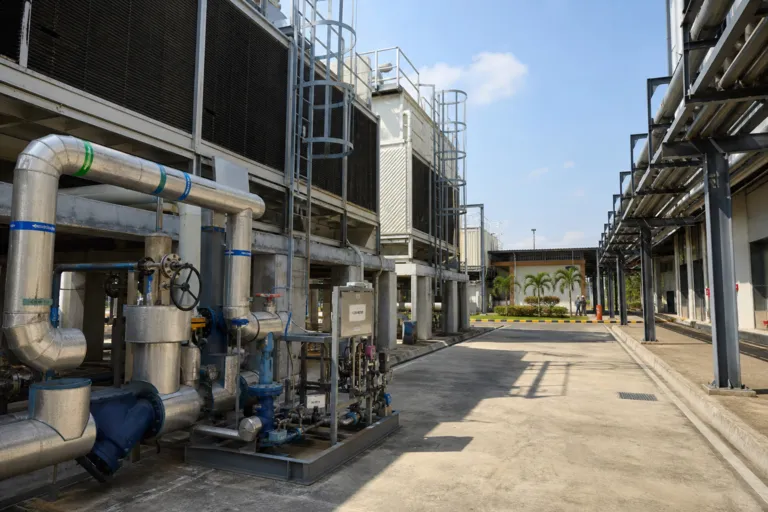
Malaysia is positioning data centres at the core of its digital economy strategy. Between 2021 and 2024, the country attracted RM184.7 billion (US$43.6 billion) in investments in data-centre-related projects, underlining how central this build-out has become. But the sustainability discussion cannot stop at electricity. Policymakers and investors are increasingly confronting the operational reality that servers run 24/7 and must be kept cold all year round, which ties energy demand directly to cooling choices and water requirements. That makes water availability, pricing, and enforceable performance standards a key part of the long-term viability story.
The scale of the growth ambition is clear in the power numbers being discussed. One analysis projects Malaysia’s data centre energy consumption to surge to over 5,000 MW by 2035, described as 40% of Peninsular Malaysia’s present power capacity, or 11.1% of Malaysia’s projected power capacity in 2035. At the facility level, the International Energy Agency (IEA) estimate cited for context is that a typical AI data centre uses as much power as 100,000 households at present, while the largest centres under construction will consume 20 times that amount. Malaysia’s leadership has also drawn a line between older models that relied on “cheap energy and water” and a push toward more selective, higher-value investments.
Johor’s Water Metrics Turn Sustainability Into Enforcement
Johor has begun to codify sustainability thresholds as mandatory enforcement metrics rather than guidelines. It mandates a Power Usage Effectiveness (PUE) of 1.8 or lower, and a Water Usage Effectiveness (WUE) threshold of 1.4 or lower. The same report frames this as narrower alignment toward Singapore’s PUE “gold standard” of 1.25, while also noting the contrast with Malaysia’s national WUE guideline of 2.2. In practice, this turns Malaysia data centre water use from a background ESG talking point into a measurable compliance requirement, influencing cooling designs and the feasibility of specific sites.
Water constraints are being reinforced by costs and infrastructure timing. Water tariffs have jumped 30% to 50% in key hubs such as Johor, Selangor and Kuala Lumpur. At the same time, S&P’s view reported that treated water supplies are likely to remain highly constrained until the late 2020s, even with Johor’s plans to lift treated water capacity to more than three billion litres per day by 2030. The same context highlights execution risk: while Malaysia’s Green Lane Pathway can shorten power approval lead times to as little as 12 months compared to three to five years in major Asia-Pacific hubs, building the actual power and water infrastructure remains a bottleneck for projects trying to enter quickly.
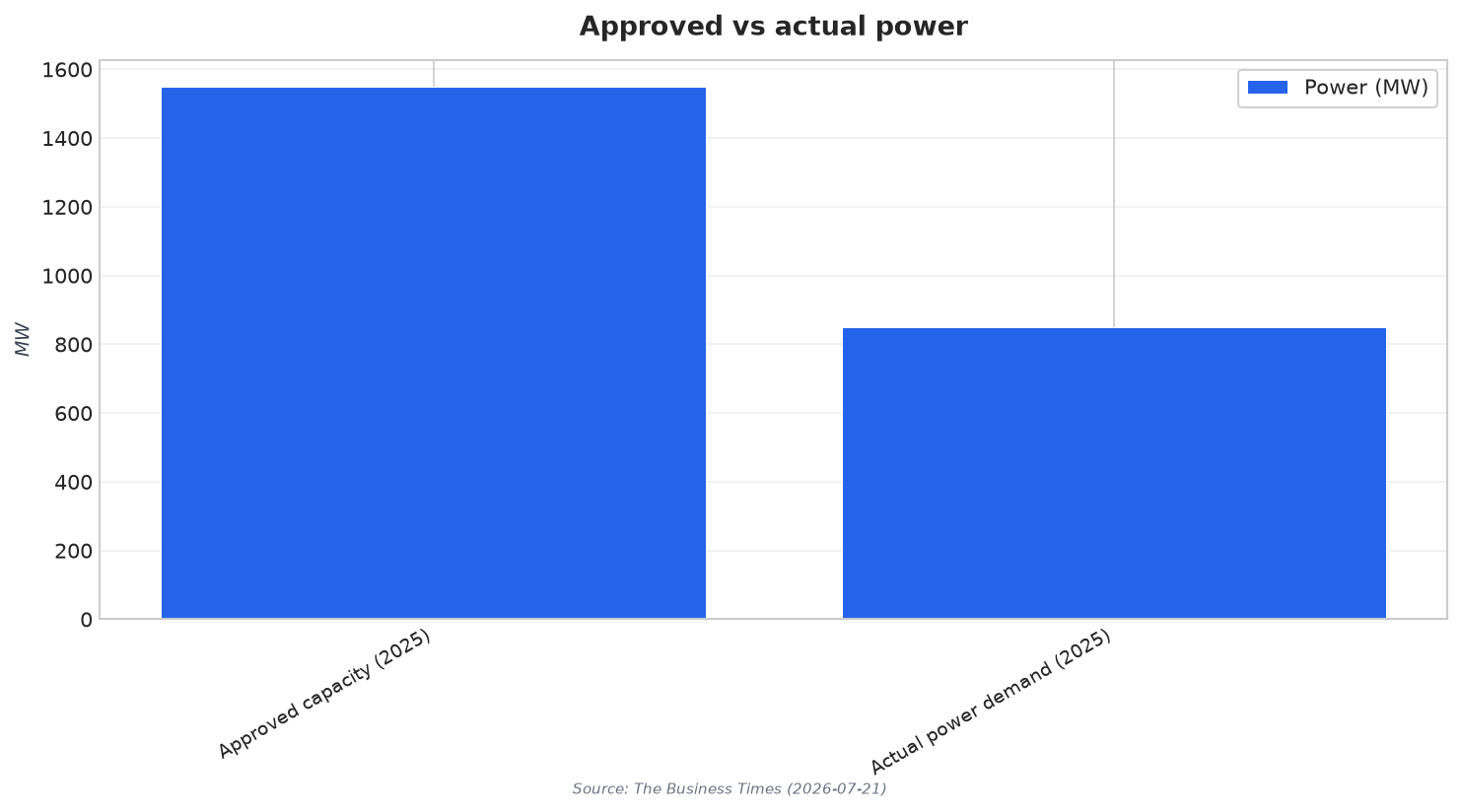
The market is also moving into a more selective phase that links approvals to resource realities. One data point shows actual power demand of 850 MW in 2025 was just 55% of 1,550 MW in approved capacity. Another report adds that state authorities rejected 30% of January–May 2024 applications to preserve power and water reserves, signalling stricter sustainability gating that could elongate approval cycles. Operators are responding by securing inputs via long-term arrangements, including renewable power purchase agreements such as Google’s 21-year corporate PPA with TotalEnergies for solar power in Kedah and DayOne’s 500 MW renewable agreement with Tenaga Nasional in 2025. These moves do not remove water limitations, but they show how project bankability now depends on proving resilience across both power and water.
Why is water becoming a major constraint for Malaysia’s data centres, not just electricity?
What water-efficiency rule is Johor enforcing for data centres?
How big is the projected power surge tied to Malaysia’s data centre expansion?
What signals show that approvals are tightening around resource limits?