
Malaysia is being discussed more often as a credible location for pharmaceutical CDMO work because the market can be evaluated through practical manufacturing and commercial realities rather than a single product code. An IndexBox strategic study on Drugs and Pharmaceuticals in Malaysia positions its analysis around demand architecture, supply capability, pricing logic, regulatory context, and competitive positioning, and it explicitly frames the audience to include CDMOs and strategic entrants. It defines the space as finished, regulated pharmaceutical products for human or animal therapeutic use, including prescription drugs, biologics, and specialty therapeutics, as defined by health authority approvals. The same report approach highlights how outsourcing, bottlenecks, and quality burdens shape supply, which is directly relevant to contract manufacturing decisions in Malaysia.
For Malaysia pharmaceutical contract manufacturing specifically, a second IndexBox report narrows in on Small Molecule Innovator API CDMO services. It defines this as process development and GMP production of novel, small-molecule APIs for innovator pharmaceutical companies. The report’s framing matters because it treats vendor selection as a long-term strategic partnership decision, not a tactical procurement exercise, which aligns with how sponsors qualify and retain CDMO partners. It also notes that assets with a strong position in high-growth, high-complexity niches like HPAPI or continuous manufacturing may command premium valuations. In addition, it flags a potential path for regional consolidation, as larger players may look to acquire specialist capabilities or geographic footprint in strategic emerging hubs like Malaysia.
Global CDMO Growth Signals a Bigger Role for Emerging Hubs
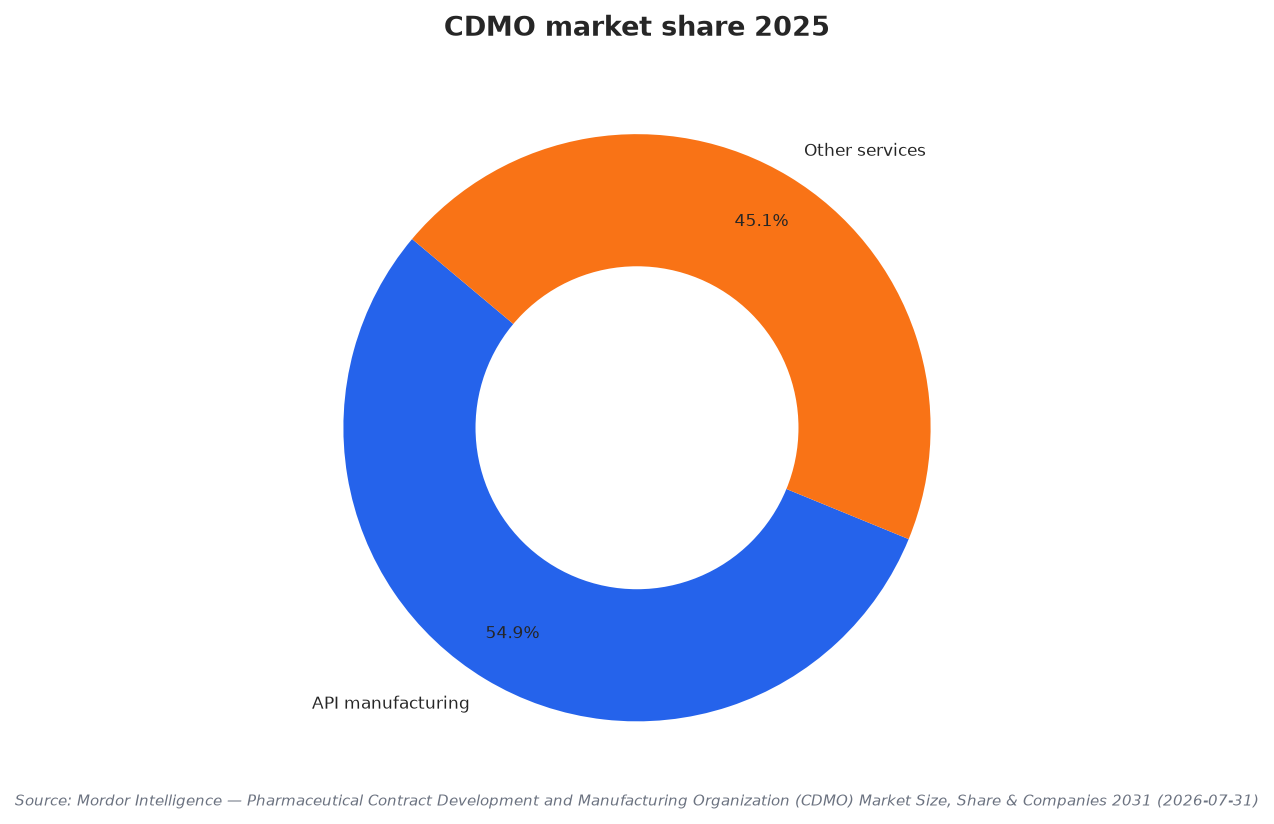
Global market forecasts give context for why sponsors keep expanding outsourcing and evaluating additional geographies. Mordor Intelligence expects the pharmaceutical CDMO market to grow from USD 258.88 billion in 2025 to USD 275.27 billion in 2026, reaching USD 374.68 billion by 2031, at a 6.33% CAGR over 2026–2031. In the same outlook, API manufacturing held 54.92% share in 2025, while finished-dosage-form development and manufacturing is forecast to expand at a 7.18% CAGR through 2031. By geography, North America led with 37.95% share in 2025, while Asia-Pacific records the highest projected CAGR at 7.18%. These figures do not describe Malaysia alone, but they help explain why Malaysia is evaluated as part of broader Asia-Pacific capacity expansion.
Other global sources point in the same direction, though their estimates differ. Grand View Research estimates the global pharmaceutical CDMO market at USD 155.5 billion in 2024 and projects USD 293.6 billion by 2033, with a 7.38% CAGR from 2025 to 2033; it also states Asia Pacific dominated in 2024 with a 37.90% revenue share. Precedence Research calculates USD 197.40 billion in 2025 and projects around USD 392.67 billion by 2035 at a 7.12% CAGR. Expert Market Research estimates USD 246.11 billion in 2025 and projects USD 588.00 billion by 2035 at a 9.10% CAGR, and notes contract manufacturing organizations secured about 73% share of the CDMO market during the historical period. Together, these sources underline a sustained outsourcing environment that can create tailwinds for Malaysia-focused CDMO strategies.
Malaysia’s hub narrative is also tied to shifting risk and investment dynamics in global manufacturing. Mordor Intelligence describes robust outsourcing demand for complex biologics, the rise of HPAPIs, and process-development platforms as factors supporting growth, and it highlights consolidation such as Novo Holdings’ USD 16.5 billion purchase of Catalent as a signal toward end-to-end providers. Expert Market Research cites real-world capacity investments like Fujifilm Biotechnologies opening a USD 3.2 billion Holly Springs facility in September 2025 to strengthen global biologics manufacturing capacity and CDMO capabilities, and Recipharm announcing a new facility in January 2026 designed to support updated FDA regulatory requirements. These examples are not Malaysia-based, but they reinforce why sponsors prioritize compliance, scale-up readiness, and integrated services—criteria that shape how Malaysia is assessed as an emerging CDMO hub.
What does “Malaysia pharmaceutical contract manufacturing” typically mean in CDMO terms?
Why is Malaysia described as a strategic emerging CDMO hub in the sources?
How fast is the global pharmaceutical CDMO market expected to grow in recent forecasts?
Which CDMO service areas stand out in the Mordor Intelligence breakdown?