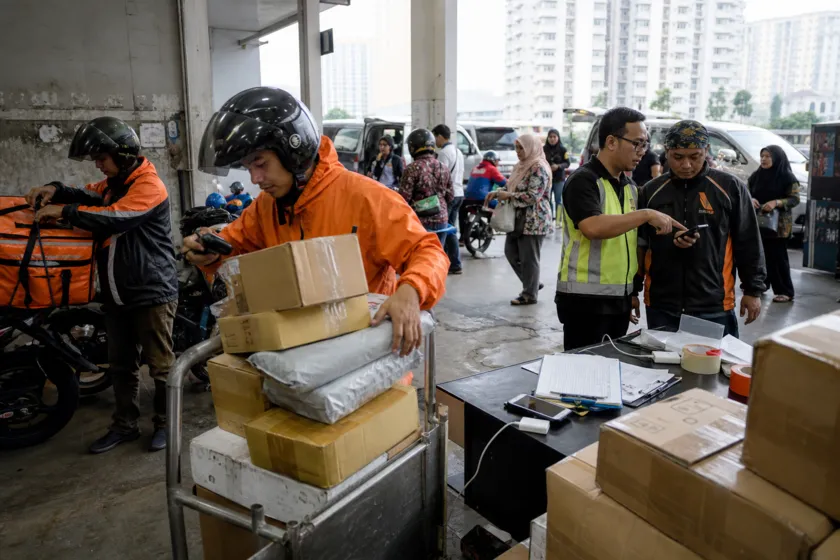
Last-Mile Delivery Malaysia is being reshaped by the push for faster fulfillment and tighter customer promises. Mordor Intelligence describes same-day fulfillment as a standard expectation in the country, noting that leading platforms ship 95% of orders within 24 hours. At the same time, 64.8% of internet users prefer free delivery, adding pressure to protect margins while improving speed. In the broader logistics backdrop, Malaysia’s freight and logistics market is expected to grow from USD 29.70 billion in 2025 to USD 31.23 billion in 2026, and is forecast to reach USD 40.11 billion by 2031, with a 5.14% CAGR over 2026–2031. Those figures frame how last-mile performance is now tied to national supply-chain priorities.
Demand is not uniform across the map, so the network response is increasingly geographic. Nexdigm highlights major logistics activity concentrated in Kuala Lumpur, Selangor, Penang, and Johor, linking volumes to large urban consumer populations, dense retail infrastructure, and connectivity with airport cargo terminals and distribution hubs. It also describes Kuala Lumpur as the primary parcel distribution center, supported by courier sorting facilities and e-commerce fulfillment warehouses, while Johor and Penang function as regional logistics gateways that facilitate cross-border trade flows and high parcel delivery volumes. This urban concentration helps explain why operators focus on dense route coverage, shorter line-hauls from hubs, and predictable cut-off times that make same-day promises feasible in practice.
Same-Day Expectations vs. Cost: The Operating Trade-Off
Speed expectations are rising, but standard services still carry much of the volume. Nexdigm segments the market by delivery type and notes that standard parcel delivery recently holds a dominant share, supported by high e-commerce order volumes, cost efficiency for retailers, and the widespread availability of courier distribution networks. The report adds that online retailers and marketplace platforms typically rely on standard delivery for nationwide fulfillment because it balances affordability with delivery speed, enabled by large-scale sorting centers and regional delivery hubs. In ASEAN context, Mordor Intelligence reports non-express held 71.20% of the ASEAN domestic courier market share in 2025, while express is forecast to grow at a 7.52% CAGR between 2026–2031. That regional split helps explain why Malaysia operators must upgrade speed without abandoning the economics that keep standard delivery viable.
Structural shifts in Malaysia’s logistics mix also matter for meeting same-day targets. Mordor Intelligence reports that, by logistics function, freight transport held 55.62% of Malaysia’s freight and logistics market share in 2025, while courier, express, and parcel (CEP) services are forecast to expand at a 5.86% CAGR between 2026–2031. It also states road freight services led with a 50.94% share in 2025, and that domestic deliveries accounted for an 84.23% share in 2025 under CEP type. These figures indicate where the operational weight sits today: road-led distribution and domestic parcel flows. For same-day delivery, that typically translates into densified local coverage, more frequent dispatch cycles from city hubs, and sharper coordination between line-haul and neighborhood handoff points.
Malaysia’s last-mile story is part of a larger global acceleration toward faster delivery promises, but local execution is the differentiator. Straits Research estimates the global last mile delivery market at USD 177 billion in 2025, projecting growth to USD 410.57 billion by 2034 at a 9.8% CAGR for 2026–2034, reflecting how customer expectations for fast and reliable delivery services are shaping investment. Grand View Research similarly estimates a global market size of USD 167.36 billion in 2025, reaching USD 348.85 billion by 2033 at a 9.8% CAGR from 2026 to 2033. These global figures provide context, while Malaysia-specific insights from Nexdigm and Mordor Intelligence point to the practical playbook: concentrate capacity in core urban states, keep standard delivery efficient nationwide, and selectively build same-day capability where demand density supports it.
What is driving same-day expectations in Malaysia’s last-mile delivery market?
Which Malaysian areas are most central to last-mile operations?
Why does standard parcel delivery remain important even as same-day grows?
How does Malaysia’s logistics market outlook support last-mile investment planning?
How do ASEAN courier trends help interpret Last-Mile Delivery Malaysia upgrades?