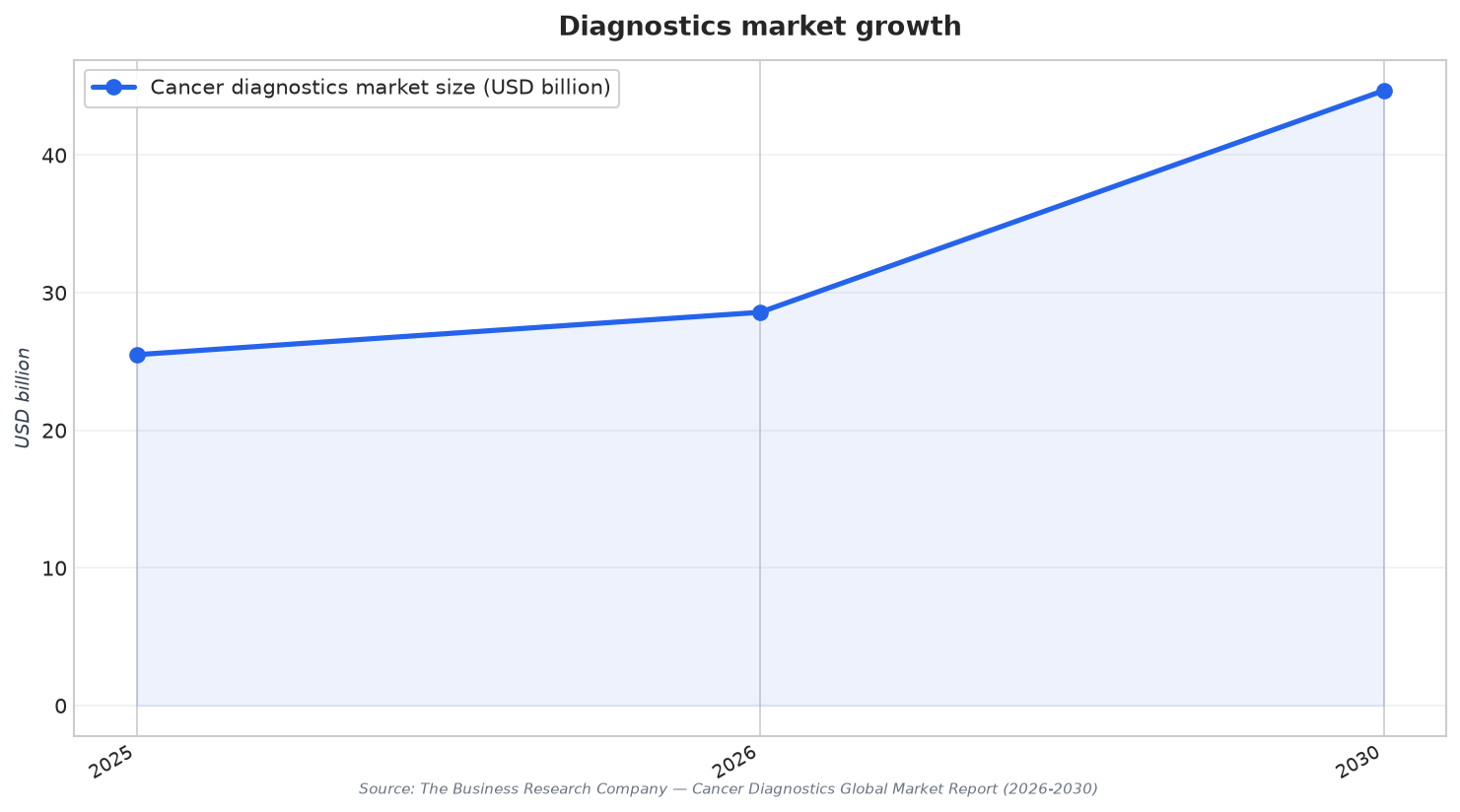
Early detection has an economic logic: it moves cancer testing earlier in the care pathway and increases the volume and variety of diagnostic activity. For readers tracking the Malaysia cancer screening market, the sources provided do not publish Malaysia-only market size figures. Still, they do show how fast the broader cancer diagnostics category is expanding and which technologies, methods, and end users are driving demand. The Business Research Company places the global cancer diagnostics market at $25.5 billion in 2025, rising to $28.58 billion in 2026, and reaching $44.69 billion by 2030 at a stated 11.8% CAGR (2026–2030). That growth narrative explicitly links to healthcare expenditure and to the expansion of population-wide screening programs.
Other sources size the same global category very differently, which matters when using international benchmarks as context for Malaysia. Future Market Insights values the global cancer diagnostics market at USD 55.7 billion in 2025, USD 60.4 billion in 2026, and forecasts USD 136.6 billion by 2036 at an 8.5% CAGR (2026–2036). Precedence Research estimates USD 170 billion in 2025, growing to USD 184.96 billion in 2026 and USD 378.44 billion by 2035, with a listed 8.33% CAGR (2026–2035) and notes North America at around 34% share in 2025. InsightAce Analytic cites USD 117.0 billion in 2025 and USD 214.6 billion by 2035 at a 6.3% CAGR (2026–2035). These ranges are global, not Malaysia-specific, but they signal that early detection is a durable investment theme.
What’s Growing Fast: Multi-Cancer Early Detection and Where Testing Happens
Multi-cancer early detection is one example of how screening economics can change, because it shifts testing toward earlier, broader rule-out workflows. Grand View Research estimates the global multi-cancer early detection market at USD 1.3 billion in 2025, USD 1.5 billion in 2026, and USD 4.6 billion by 2033, growing at a 17.2% CAGR (2026–2033). In that same study, North America holds 37.6% of global revenue share in 2025, and hospitals account for 48.5% of end-use revenue share in 2025. This is not a Malaysia reading, but it highlights a practical point for local planning: much of the spending follows care settings that can scale testing volumes and coordinate follow-up diagnostics.
Across cancer diagnostics more broadly, multiple sources describe a similar center of gravity around hospitals, labs, and test-intensive workflows. Future Market Insights projects hospitals will account for 48.0% of end-user demand in 2026, and it expects blood samples to represent 41.0% of sample demand in 2026, reflecting the rise of sample-based workflows that can support early testing. Precedence Research’s global segmentation also points to scale effects: consumables at 61% of market share in 2025, IVD testing at 62.3% by technology, and hospitals and clinics at 53% by end user (all global, 2025). For Malaysia’s screening and diagnostics ecosystem, these global splits help illustrate where operating budgets can concentrate as testing volumes rise.
Finally, the “economics” of early detection is also shaped by which cancers and methods screening programs prioritize and how technology improves throughput. The Business Research Company lists methods such as biopsy, endoscopy, tumor biomarker tests, and imaging, and it flags a market trend in AI advancements in cancer diagnostics devices. Roots Analysis connects market expansion to innovation in liquid biopsies, next-generation sequencing (NGS), and imaging, while also citing a U.S.-specific screening signal: the U.S. Preventive Services Task Force recommended screening for prostate, breast, cervical, lung, and colorectal cancers, and Roots Analysis states these methods helped diagnose nearly 40% of these cancers (U.S. context). Malaysia’s direction will depend on local policy and capacity, but global data indicates that earlier testing, higher screening participation, and test automation are central levers for market growth.
Are there Malaysia-specific market size figures in these sources?
What do the sources say about global cancer diagnostics growth?
How fast is the global multi-cancer early detection market growing?
What do the sources suggest about where demand concentrates in screening and diagnostics?
What is influencing the Malaysia cancer screening market, based on global signals in the sources?