
Malaysia’s Budget 2026 was tabled on 10 October 2025 and is valued at RM470 billion in total spending. The Prime Minister expects the economy to grow at 4 to 4.5%, framing a planning baseline for many firms. Another breakdown cited alongside Budget 2026 allocates RM419.2 billion to rakyat welfare, targeted subsidies, and cash aid, while keeping income tax unchanged and emphasizing subsidy retargeting. For businesses, this combination matters because it influences consumer resilience while also signaling that policy attention is shifting toward enforcement and compliance rather than broad-based new taxes.
A major operational takeaway is how Budget 2026 links spending priorities to workforce readiness and household services. One report notes the social sector receives MYR127.3 billion, with MYR74.4 billion for education and MYR40.1 billion for training and health services. In parallel, public health staffing measures include offering permanent positions to 4,500 contract doctors and nearly 935 Ministry of Health Training Institute graduates as nurses. For employers, these moves can affect wage competition in certain occupations, while expanded personal tax reliefs (such as childcare coverage up to age 12 and disabled child relief rising from RM6,000 to RM10,000 per year) can shape employee cost-of-living pressure and retention conversations.
Where Budget 2026 Creates Direct Business Tailwinds
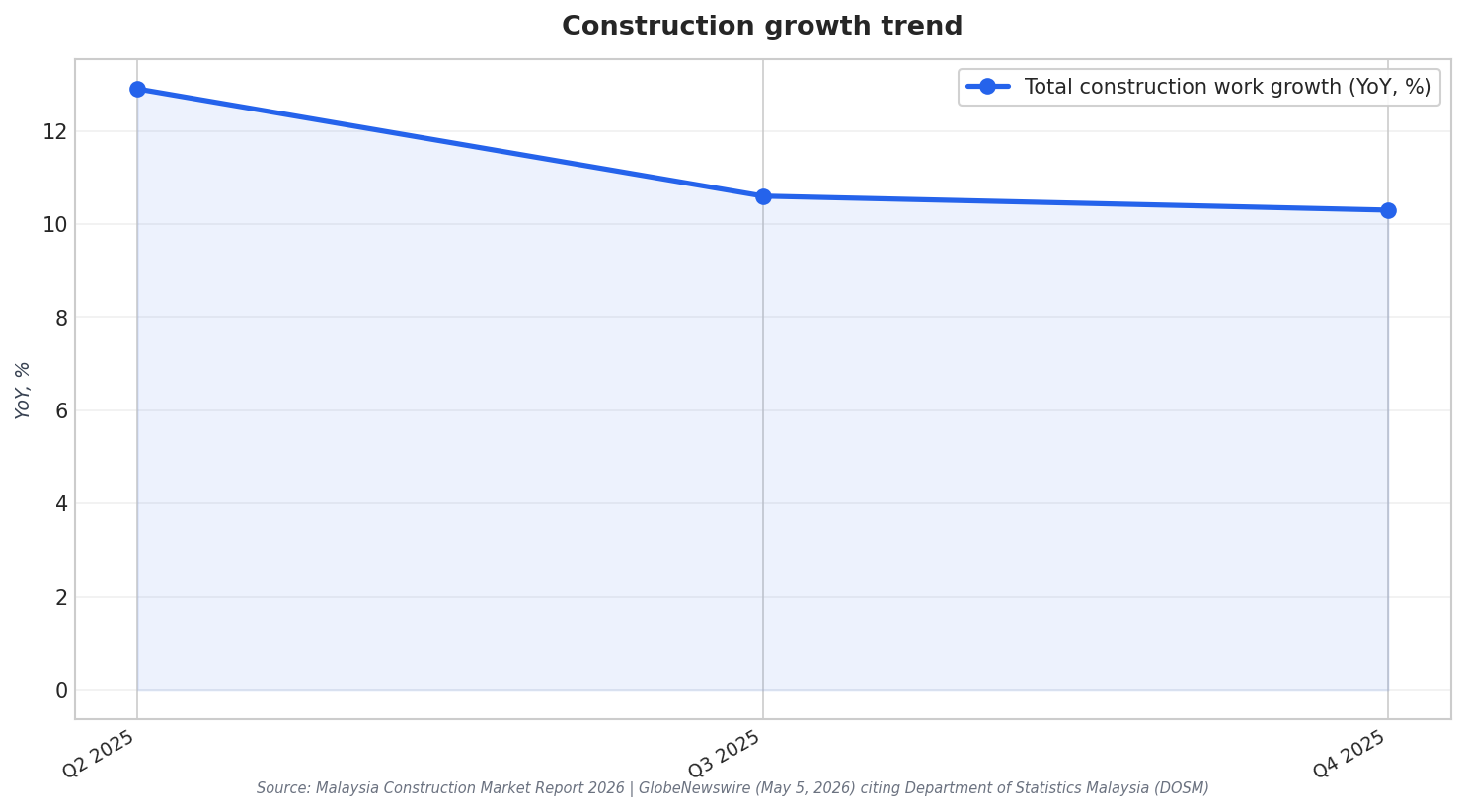
Construction and infrastructure-linked demand is one of the more measurable channels. A market report projects Malaysia’s construction industry will expand by 6.5% in real terms by 2026, citing investments in transport infrastructure and governmental allocations within the 2026 Budget. DOSM figures in the same report show the total value of construction work rose 10.3% year on year in Q4 2025, following 10.6% in Q3 2025 and 12.9% in Q2 2025. The breakdown matters for contractors and suppliers: residential construction grew 5.9% YoY in Q4 2025, while non-residential grew 18.6% and civil engineering grew 3.6%.
Budget-linked initiatives also signal modernization spending, especially for firms that can sell into industrial upgrades and digital capability building. Under the New Industrial Master Plan 2030 (NIMP 2030), the manufacturing sector’s GDP is targeted to rise from MYR364.9 billion in 2022 to MYR587.5 billion by 2030, and plans include upgrading 3,000 factories into smart factories with an estimated MYR5 billion investment. For SMEs, one business brief highlights a RM53 million AI adoption grant via MDEC for SMEs deploying AI in areas like forecasting, marketing, and customer support, plus a 50% additional tax deduction for AI and cybersecurity training under the National AI Office.
Compliance and sector-specific procurement complete the Malaysia Budget 2026 Business Impact picture. Budget commentary highlights improved enforcement through nationwide e-invoicing, digital stamp duties, and stronger anti-smuggling measures, while also noting MSMEs benefit from loan and guarantee schemes alongside automation and AI incentives. Separately, Malaysia’s 2026 defense budget is set at RM21.7 billion (approximately US$5.4 billion), a 2.9% increase, with a focus on maritime security and procurement reform after a freeze in January 2026. For vendors, the practical response is to align sales pipelines with sectors seeing explicit allocations, and to treat digital compliance readiness as a competitive requirement, not just a finance task.
How does Budget 2026 frame the Malaysia Budget 2026 business impact for planning?
What construction indicators matter most for businesses selling into projects?
What AI and training support is highlighted for SMEs?
What are the key compliance changes businesses should prepare for?
What does the 2026 defense budget imply for suppliers?