Malaysia’s logistics operators are under pressure to move more freight with tighter control over cost and compliance. In this environment, Malaysia fleet telematics is increasingly positioned as an operating system for trucks and vans, not just a tracking add-on. Mordor Intelligence forecasts Malaysia’s road freight transport market at USD 9.02 billion in 2026, growing at a 4.93% CAGR to USD 11.47 billion by 2031. That growth sits alongside practical constraints, such as sensitivity to toll-rate escalations and driver-rest compliance, which the same source says is pushing fleets to invest in telematics that optimize rest-stop timing and lane speeds. As infrastructure changes, the operational upside becomes clearer. The West Coast Expressway opening to Lumut in late 2025 improves safety and turnaround times and can enable an extra daily trip on Klang–Teluk Intan loops, raising the value of tools that coordinate schedules and reduce avoidable delays.
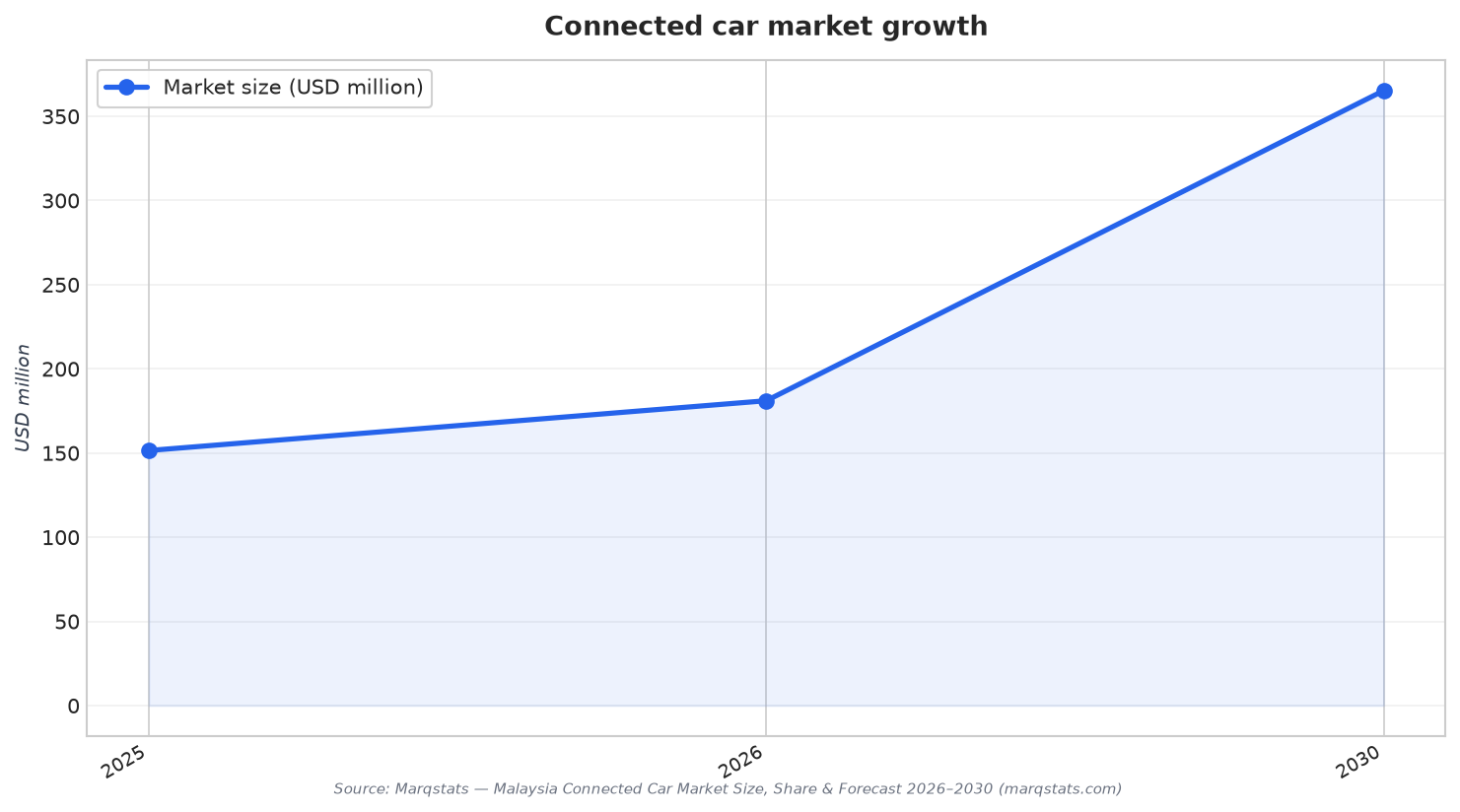
Connected-vehicle capability is also expanding through the broader connected car ecosystem. Marqstats values Malaysia’s connected car market at USD 151.51 million in 2025 and projects it to reach USD 365.28 million by 2030 at a 19.24% CAGR. In unit terms, it projects new connected vehicle shipments rising from 258,000 to 535,000 units, a 15.70% unit CAGR. Marqstats also frames this market across four revenue layers, explicitly including commercial fleet telematics alongside factory-installed hardware, recurring cellular connectivity fees, and software and cloud subscriptions. It notes that Perodua and Proton sold a combined 511,468 vehicles in 2025, representing 62.3% of total industry volume, and describes this concentration as a key constraint on the pace of factory-embedded connectivity. The same report explains it focuses on vehicles with a factory or certified aftermarket telematics control unit and an embedded machine-to-machine SIM capable of bi-directional cellular data transmission, and excludes tethered smartphone-projection systems.
How Telematics Cuts Costs in Transport Operations
For cost reduction, the strongest claims in the provided sources tie to routing, fuel behavior, and maintenance planning. Congruence Market Insights states that by 2028, AI-based routing and predictive maintenance can reduce fleet operating costs by 8–15% and unplanned vehicle downtime by 15–25%. In a 2026 pilot-style example, it adds that deployments combining AI routing and predictive maintenance are targeting 10–15% lower fuel and maintenance expenditure while improving vehicle utilization by approximately 5–10%. Another source, Business Outstanders, reports that fleets using telematics save 15–20% on fuel costs by optimizing routes, reducing idling, and improving driving habits, and that preventative maintenance through telematics cuts repair costs by 25–30% and reduces vehicle downtime. Used carefully in Malaysia, these levers align with what road freight operators face day-to-day: fluctuating trip density, queue time, and the need to keep assets running without surprise failures.
Global market sizing provides context for how much vendor investment is chasing these outcomes, but it should not be read as Malaysian revenue. Market Research Future projects the fleet telematics market will reach USD 51.59 billion at a 9.82% CAGR during 2026 to 2035. Congruence Market Insights values the global transportation and fleet management solutions market at USD 14,512.4 million in 2025 and anticipates USD 28,078.8 million by 2033 at an 8.6% CAGR, with logistics and transportation representing approximately 40–45% of solution demand. Market Growth Reports sizes the commercial fleet telematics services market at USD 7,489.05 million in 2026, reaching USD 13,336.28 million by 2035, and expects vehicle management to account for 48% of service demand while transport and logistics represent 46% of application demand. For Malaysia’s operators, the practical takeaway is that mainstream platforms are being built around the same cost drivers they care about: real-time visibility, preventive maintenance, and route optimization.
Implementation in Malaysia should be framed around what can be measured and acted upon. Start with routes, rest-stop timing, and speed discipline, because Mordor Intelligence links telematics investment to optimizing rest-stop timing and lane speeds under compliance pressure. Add maintenance automation and diagnostics, because multiple sources emphasize predictive maintenance and downtime reduction, and Congruence Market Insights quantifies potential reductions in unplanned downtime of 15–25% by 2028. Finally, align telematics with the connected-vehicle path described by Marqstats: growth in embedded connectivity and shipments can expand the pool of vehicles capable of bi-directional cellular data transmission, while certified aftermarket options remain relevant where factory fitment is limited. With these steps, connected vehicles become a cost-control tool that supports both day-to-day dispatch and longer-term fleet planning.
What is driving demand for fleet telematics in Malaysia’s road freight sector?
How can connected routing and predictive maintenance reduce fleet costs?
How big is Malaysia’s connected car market, and why does it matter for fleet telematics?
What vehicle capability qualifies as “connected” in the Marqstats definition?
What should companies expect from Malaysia fleet telematics programs focused on fuel and maintenance?