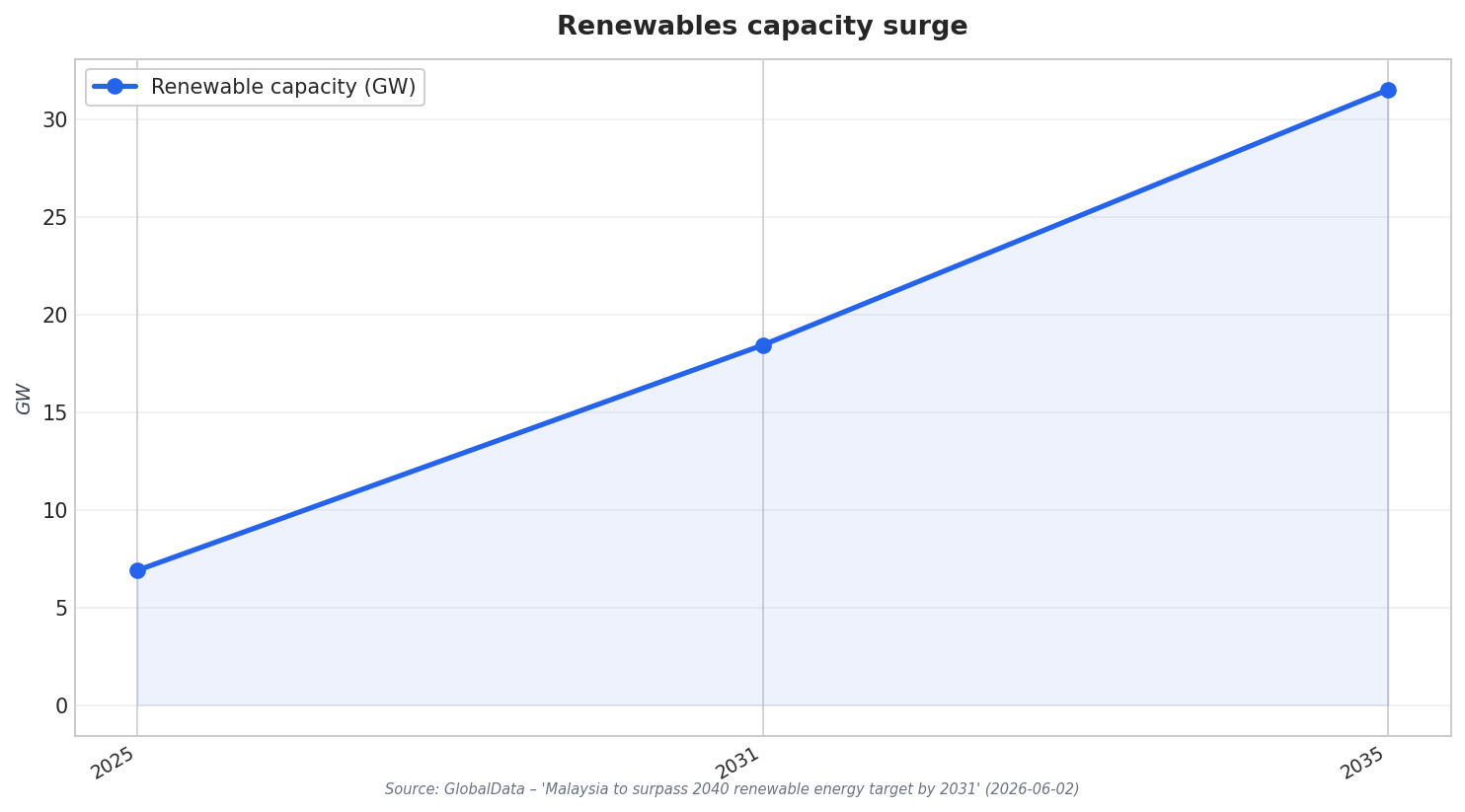
Malaysia’s power system is entering a build-and-upgrade cycle where grid readiness matters as much as generation. GlobalData forecasts renewable capacity rising from around 6.9 GW in 2025 to approximately 31.5 GW, with renewable generation estimated to increase from 10.1 TWh in 2025 to 46.4 TWh in 2035. At the same time, Malaysia is poised to exceed its National Energy Policy (NEP) 2040 renewable capacity target of 18.43 GW by 2031. This combination of volume growth and accelerating timelines makes grid integration, storage, and operational flexibility central to planning.
Demand growth is also changing the grid’s load shape. GlobalData points to surging electricity usage “both day and night” driven by data centers, electric vehicles, cooling systems, and industrial processes, which supports investment in grid expansion and modernization. Mordor Intelligence similarly links the growth outlook to the National Energy Transition Roadmap (NETR) and rising corporate power-purchase agreements tied to a data center boom. Under NETR, the report cites binding targets of 31% renewable energy by 2025 and 40% by 2035, creating clearer revenue visibility for developers while raising the operational need for stronger transmission, distribution, and control capabilities.
What Grid Modernization Looks Like in Malaysia
Modernization is being expressed through funding, grid reinforcement, and smarter tools. Mordor Intelligence cites Tenaga Nasional Berhad (TNB) capex of MYR 42.9 billion (USD 10.2 billion), with 64% earmarked for grid reinforcement, including new inter-regional circuits and advanced system operator tools. It also notes that NETR measures can ease a 24% solar-penetration cap on peak demand, creating additional headroom for variable generation. Alongside this, Ken Research reports the Malaysian government allocated RM 1.5 billion for smart grid initiatives under the 12th Malaysia Plan, supporting advanced grid technologies, including self-healing capabilities, to enhance reliability and efficiency.
Solar integration strategies increasingly point toward siting and storage decisions that reduce grid friction. GlobalData highlights the use of ground-mounted and floating solar farms “in tandem with battery storage,” describing how floating solar can capitalize on waterbody sites already equipped with transmission infrastructure and reduce grid connection delays. Battery storage is described as a way to capture excess midday power and supply energy during evening peak hours, improving grid utilization and stability. Mordor Intelligence adds that the NETR mandates 2.5 GW of floating-solar deployments atop hydro dams and five centralized 150 MWp solar parks, directly addressing land scarcity constraints.
Digitalization and AI are becoming part of the grid narrative, not just an end-use driver. ABB research says AI can enable smarter, data-driven energy management, encourage greater investment in advanced smart grid technologies, and improve interoperability across energy infrastructures. In the same research, almost three quarters (63%) of organizations call for stronger government incentives, 61% want more cross-regional collaboration on grid infrastructure, and 52% advocate for increased private sector investment. These preferences align with broader efforts cited by Ken Research, including plans to connect power grids between Peninsular Malaysia and Sarawak to expand green electricity infrastructure and enhance grid resilience.
How fast are renewables expected to grow, and what does that mean for the grid?
What specific spending signals support grid upgrades in Malaysia?
How is solar being integrated to reduce grid connection delays?
How do AI loads and data centers connect to Malaysia’s grid planning?
What is Malaysia Power Grid Modernization focusing on to handle variable renewables?