Malaysia’s private medical coverage market is under affordability pressure, and regulators are responding with a package of reforms that includes the base Medical and Health Insurance/Takaful (MHIT) plan. Bank Negara Malaysia (BNM) has positioned RESET and the base MHIT product as a response to medical inflation and persistent concerns over the affordability of private health cover, while keeping public hospitals as the primary safety net. The base plan is described as a simpler, standardised option, designed to make it easier for consumers to understand coverage and keep it sustainable over time. In parallel, the World Bank’s work using de-identified insurer-paid claims from the centralized claims database (covering 2022–2024) adds evidence on what is driving spending and where hospital efficiency improvements may be possible.
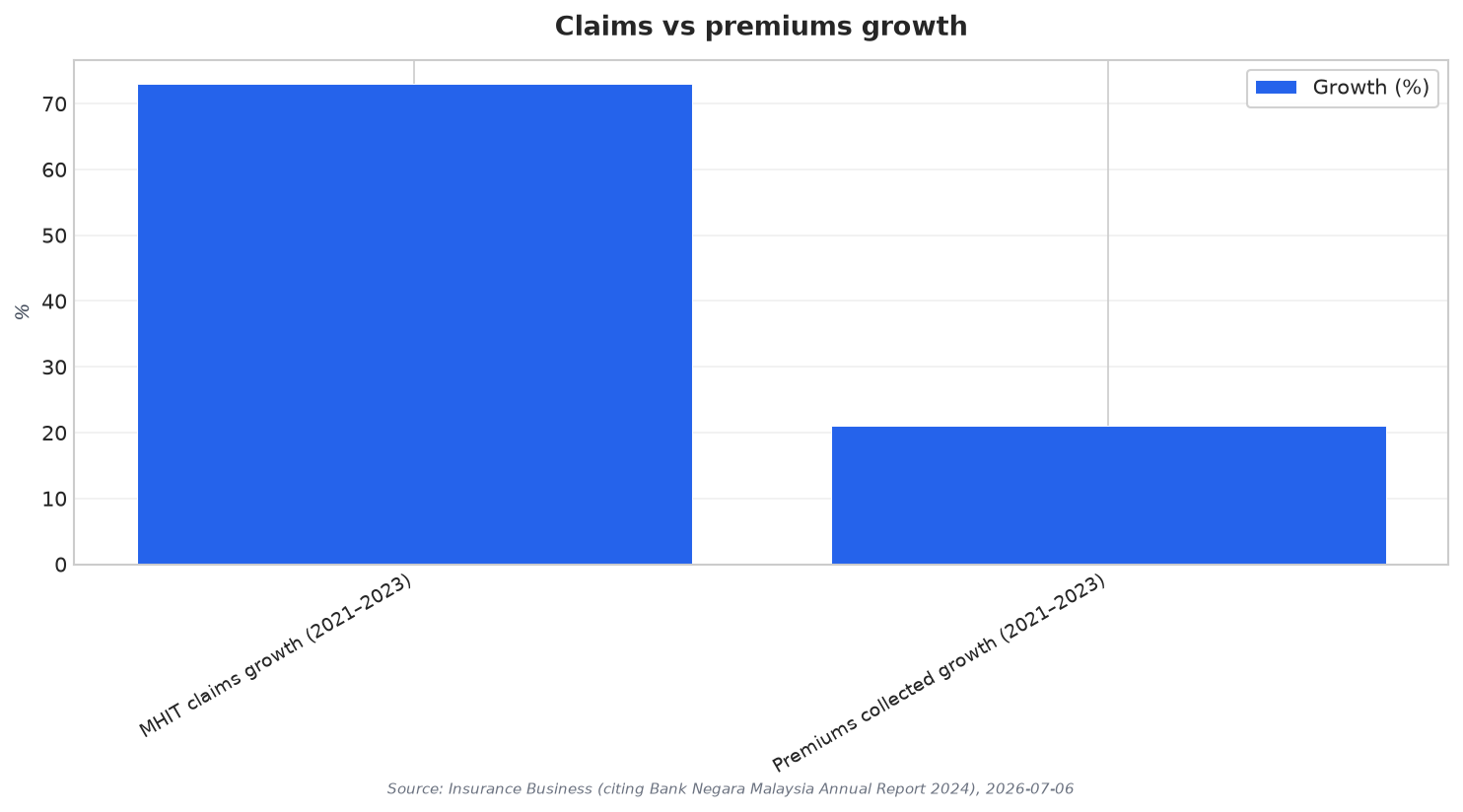
For insurers and takaful operators, the near-term market impact is shaped by the gap between claims and premiums. BNM’s Annual Report 2024 quantified that total MHIT claims rose 73% between 2021 and 2023, while premiums collected grew 21% over the same period. Separately, the New Straits Times reported MHIT takaful claims reached RM6.75 billion in 2023, described as a six-fold increase since 2003. These figures help explain why BNM has managed interim premium adjustment measures for 2024–2026, and why operators are being asked to adapt their product design, underwriting discipline, and claims governance rather than relying only on repricing. A standardised base MHIT plan is scheduled for pilot implementation in the second half of 2026 and full rollout in early 2027, timed to the expiry of the interim measures.
How RESET and the Base Plan Change Insurer Competition
As a market design change, the base MHIT plan is positioned as Malaysia’s first standardised standalone medical plan, with defined benefits, authority-set pricing, and mandatory portability between insurers and takaful operators. That combination shifts competition away from opaque benefit structures and towards service execution, claims experience management, and operating efficiency. Policy discussions also include access expansion for individuals with stable, controlled pre-existing conditions, where BNM states a key objective is to expand access for people who often face difficulty obtaining cover. BNM is also considering a “no look-back” provision, under which after a period of continuous coverage, insurers would not deny claims solely on the basis of pre-existing conditions. For older age bands, the base structure is designed to moderate sharp premium increases later in life.
Hospitals are central to the cost equation because the World Bank’s claims analysis highlights utilization and hospital-linked billing components as major drivers. From 2022 to 2024, total claims rose substantially across major service categories, with particularly fast growth in pre-hospitalization and post-hospitalization claims. The report finds cost growth is largely driven by volume (utilization), accounting for three quarters of all cost growth, followed by higher service charge prices. It also notes that the share of claim amounts due to hospital supplies and services (HSS)—including medical supplies, laboratory tests, and exams—is over 70% and rising. On the clinical pathway side, about one-fourth of inpatient admissions (23.6% in 2024) are potentially preventable with longer-term strengthening of primary care, including prevention, early detection, and chronic disease management.
For the wider ecosystem around Malaysia MHIT medical insurance, the practical implication is a stronger link between financing reform and delivery reform. BNM has said engagement with ministries, private hospitals, doctors, insurers, takaful operators, and consumer groups has surfaced recurring themes: premium affordability, long-term sustainability, and how health delivery reforms interact with insurance. RESET is framed as more than the base plan, with emphasis on price transparency and closer cooperation among hospitals, insurers, doctors, and regulators. With standardized benefits and portability, hospitals may face greater pressure to show value and manage operational efficiency, while insurers will need to manage utilization intensity and claims processes to protect sustainability without making products harder to understand or access.
What is the base MHIT plan meant to achieve in Malaysia’s medical coverage market?
What do recent figures show about MHIT claims versus premiums in Malaysia?
What does the World Bank claims database analysis say is driving cost growth?
When will the standardized base MHIT plan be implemented?
How could Malaysia MHIT medical insurance reforms affect hospitals?