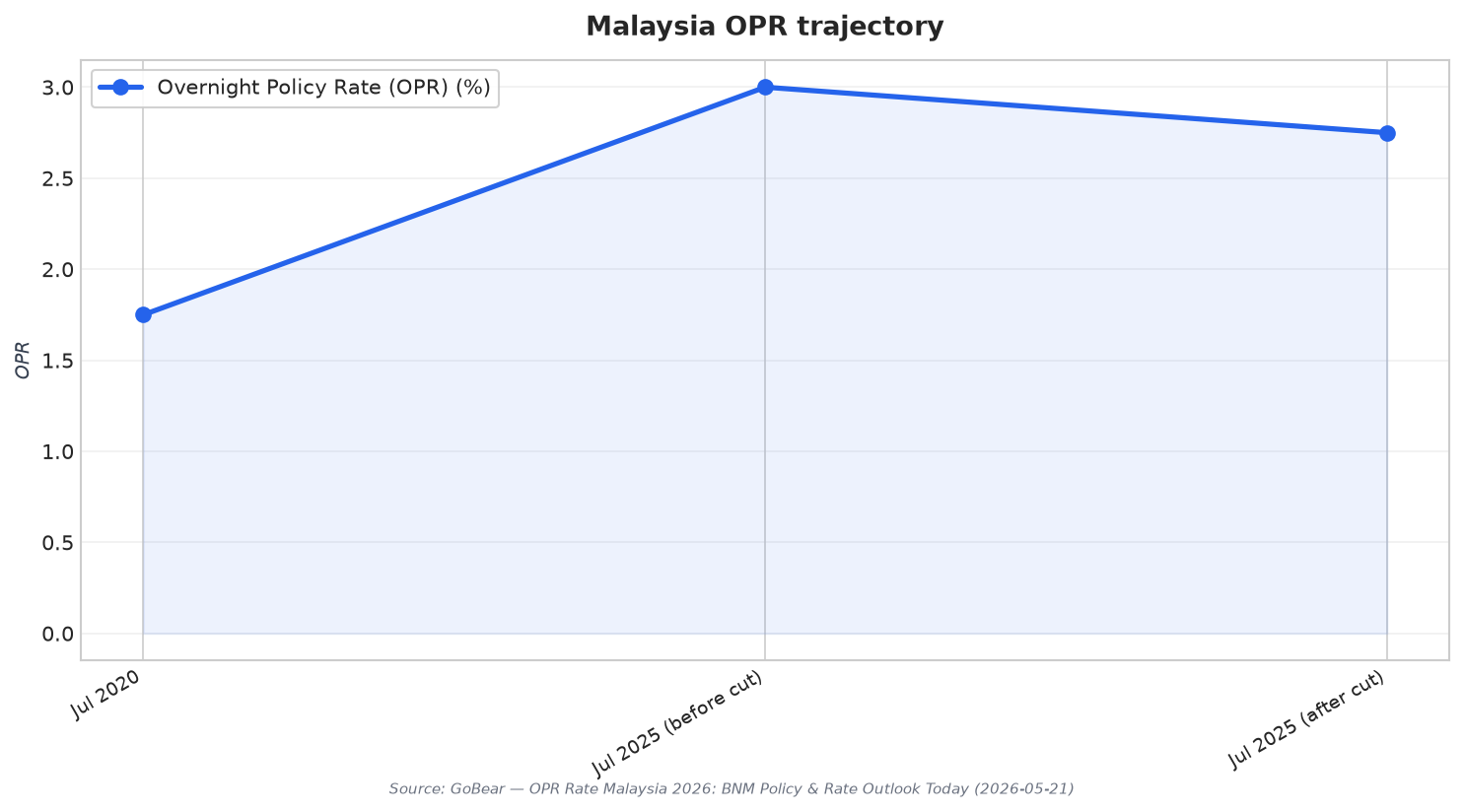
Bank Negara Malaysia (BNM) has kept the Overnight Policy Rate (OPR) at 2.75%, maintaining the rate for a seventh consecutive meeting. The rate has been at 2.75% since a 25-basis-point cut from 3.00% on 9 July 2025, and it remains the lowest level since the Covid-19 pandemic era, when the OPR was cut to 1.75% and stayed there until 9 July 2025 before being raised back to 3%. The OPR is BNM’s key policy rate and influences interest rates across the banking system, including loans and deposits, though not every product moves one-for-one with the policy rate. For households and businesses, a prolonged hold matters most because it extends predictability in financing conditions.
BNM’s Monetary Policy Committee (MPC) does not use a fixed formula to set the OPR. Instead, it assesses the outlook for inflation and economic growth, along with risks such as domestic demand, financial conditions, and global developments. In explaining the decision to keep the OPR unchanged, BNM said the current stance was consistent with continued price stability and sustainable economic growth. In the data BNM cited, Malaysia’s economy grew by 6% in the second quarter of 2026, while headline inflation stood at 1.8% in July. Other recent readings included headline inflation at 1.9% year on year in June 2026, down from 2.0% in May, and an advance estimate showing the economy grew by 5.6% in the first half of 2026, with BNM’s full-year growth projection remaining between 4% and 5%.
What a Prolonged Hold Changes for Borrowers, Banks and Property
For borrowers, the most direct channel is variable-rate lending. A steady OPR generally helps keep variable-rate housing loans and personal financing facilities at existing interest levels, reducing the risk of sudden jumps in monthly instalments. For floating-rate home loans priced against benchmark base rates, staying at 2.75% means borrowers keep this lower base for now, which can make budgeting easier. However, loan pricing is still bank-specific, shaped by funding costs, borrower risk, and package features, while fixed-rate loans are generally less affected by short-term policy moves. Practical decisions also matter: one analysis notes that on a RM400,000 outstanding balance, a 0.25% difference in effective rate is roughly RM1,000 a year in interest, and that some pre-2024 loans may carry spreads 0.3% to 0.8% above what banks offer new customers with the same profile.
For banks, holding the OPR steady supports a more stable planning environment, but it does not freeze competition. Because OPR is a policy signal and banks set their own lending and deposit rates, pricing can still shift based on competition, credit risk, and funding conditions. In the interbank market, BNM guides unsecured overnight ringgit rates close to the OPR through liquidity operations; as of 23 July 2026, the Malaysia Overnight Rate (MYOR) was 2.75%, aligning with the policy rate. For depositors, the same stability can be a trade-off: without an OPR rise, interest returns on savings are less likely to increase, though a hold also avoids the lower interest earnings that could come with a rate cut. Some commentary also frames the environment as supportive for real purchasing power when inflation figures average under 2%.
For property, the key impact is confidence and affordability at the margin. Lower borrowing costs can support household spending, property purchases, and business investment, while existing floating-rate borrowers are less likely to see OPR-driven changes in repayments during a hold. That steadiness can give homebuyers more certainty when planning monthly commitments, especially when the broader narrative points to resilient growth momentum supported by stronger-than-expected exports alongside sustained domestic demand. The Malaysia OPR outlook, in this context, is less about predicting the next move and more about understanding what prolonged stability means: slower shifts in mortgage pricing, clearer budgeting for buyers, and a longer window for borrowers to review whether their loan spread still matches current market offers, factoring in possible refinancing costs such as legal fees and valuation that can range from RM3,000 to RM10,000.
Why is BNM keeping the OPR at 2.75%?
Will a prolonged OPR hold change my floating-rate home loan instalment?
What does an OPR hold mean for deposit and savings returns?
How can borrowers check if their home loan pricing still makes sense?
What is the Malaysia OPR outlook for people planning loans and property decisions?