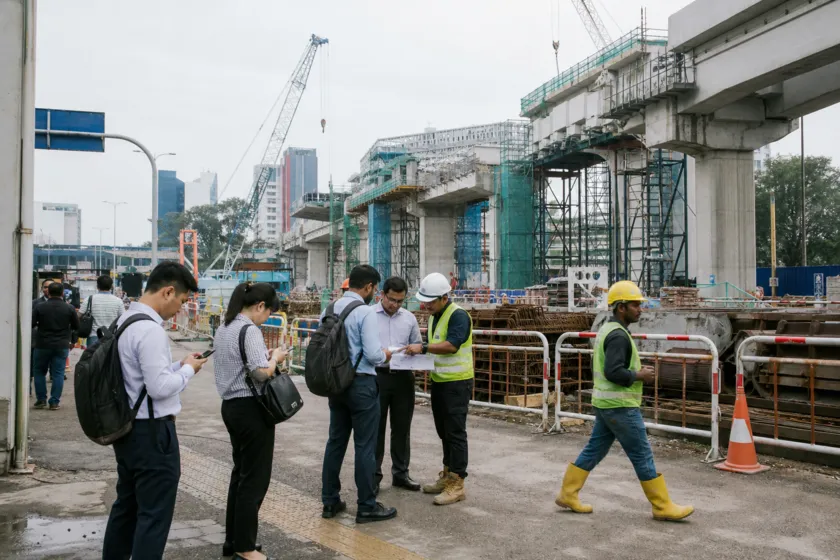
The Johor Bahru–Singapore Rapid Transit System, widely known as the RTS Link, is a 4 km (2.5 mi) twin-track rapid transit connection across the Strait of Johor. It will link Bukit Chagar station in Johor Bahru, Malaysia, to Woodlands North station in Singapore, where it connects to Singapore’s MRT network. Operations are targeted to begin from January 2027, and multiple reports also describe an operational window of late 2026 or early 2027. For commuters, the core promise is simpler than hype: a dedicated rail shuttle that reduces dependence on road crossings and makes cross-border routines easier to plan.
A major design feature is pre-boarding border processing. Both stations will house customs, immigration and quarantine (CIQ) facilities for both countries, and these will be independent from the existing CIQs at the Sultan Iskandar Building and Woodlands Checkpoint. On the Johor side, sources describe the Bukit Chagar Integrated Immigration, Customs and Quarantine (ICQ) complex as including 100 AI-powered e-gates, aimed at making clearance more tolerable and efficient. This focus on process, not just track, matters because it targets the bottlenecks that often define the cross-border experience.
Capacity, Travel Time, and What It Could Shift
In operation, the link is described as a short, high-frequency shuttle with no intermediate stops, designed to move large volumes quickly. Sources state it is designed to transport up to 10,000 passengers per hour per direction during peak periods. The trip itself is described as a quick hop: several sources cite an approximately five-minute journey, while one notes the cross-border trip is expected to span about six minutes. Ridership expectations in the sources include 40,000 passengers daily at launch, with longer-term plans or expectations that it could service about 140,000 daily. Some reporting frames that upper figure as around 30% to 40% of current Causeway traffic, and another estimate says it can handle approximately 40% of traffic across the Johor Causeway once fully operational.
The broader context is persistent congestion at the Johor–Singapore Causeway. Sources describe daily crossings exceeding 300,000, and one notes the Causeway currently serves over 300,000 travellers daily by road. By moving a meaningful portion of demand onto rail, the RTS is positioned as a reliability play as much as a speed play. A contributed property-market commentary also argues that the most significant factor is the expected certainty and regularity of the service, especially because it is integrated with Singapore’s MRT network. That predictability can reshape how frequent travelers plan work, school, and appointments across the border.
The new line also intersects with existing services and longer-term network planning. Wikipedia notes that when completed, the RTS Link will replace the KTM Shuttle Tebrau service between JB Sentral and Woodlands Train Checkpoint stations by June 2027, while also reporting that the Malaysian government has expressed its intention to maintain the KTM service to the Singaporean government. On the Johor side, the RTS Link is described as Malaysia’s first LRT system outside the Klang Valley and is expected to be part of a planned comprehensive integrated network. For readers tracking the RTS Link Johor Bahru Singapore story, these details signal a shift toward a more structured cross-border rail ecosystem, not just an isolated shuttle.
When is the Johor Bahru–Singapore RTS Link targeted to start operations?
How long is the RTS Link route and which stations does it connect?
What passenger volumes are expected at launch and over the longer term?
How will border clearance work on the RTS Link?
What happens to the KTM Shuttle Tebrau after the RTS Link opens?