Warehouse automation and robotics are shifting from “nice to have” to a defining differentiator for logistics operators. In Malaysia, Mordor Intelligence describes a fragmented market where ports are concentrated but trucking, courier, and value-added warehousing remain highly atomized. Against that backdrop, automation investments are framed as the edge that separates leaders from followers. One example cited is MR DIY, where robotic fulfillment delivered 200% efficiency gains and shorter pick cycles, raising the pressure on rivals to digitize and modernize their warehouse processes.
Demand conditions are also tightening the case for automation. Record MYR 378.5 billion (USD 82.3 billion) investment approvals in 2024 are channeling funds into semiconductor fabs, advanced automotive components, and renewable-energy assemblies, according to the same Malaysia freight and logistics source. It also notes that semiconductor-linked logistics is triggering demand for electrostatic-discharge-compliant packaging, secure robotics, and bonded-warehouse clearance lanes. Separately, free-delivery preferences among 64.8% of internet users are pushing providers toward automated sortation, micro-fulfillment centers, and data-driven route planning, because service expectations keep rising even as operational bottlenecks persist.
Robotics Momentum Is Global, and It Sets the Benchmark
Global benchmarks illustrate how quickly the technology base is scaling. SellersCommerce reports that by the end of 2026, around 4,691,685 commercial warehouse robots will be installed worldwide across over 50,000 warehouses. The same source says companies adopting automation are seeing 25–30% reductions in labor costs, order fulfillment speeds that are 300% faster, and accuracy rates approaching 99%. It also notes that over 450,000 logistics robots were sold globally in 2025, compared with 75,000 in 2019, which it describes as a 500% increase. For Malaysia, these figures are not local outcomes, but they do set the operational standard local shippers and 3PLs are increasingly expected to match.
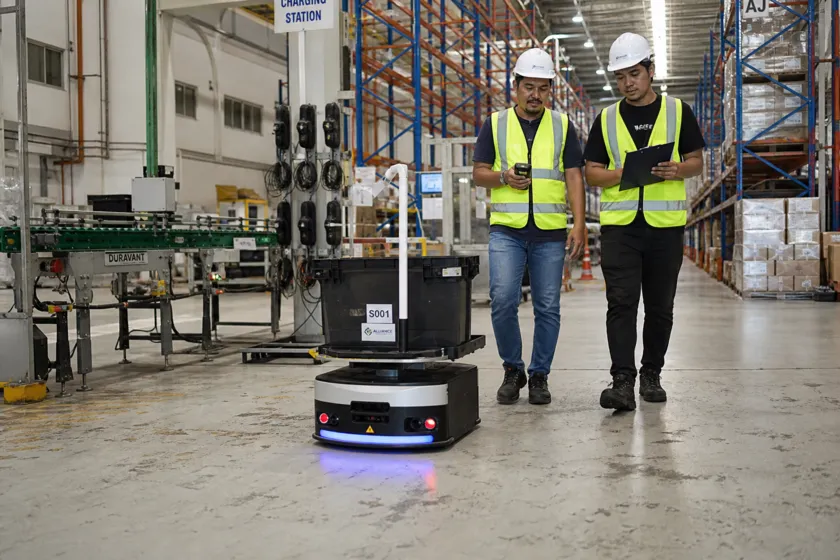
Mobile robots are a major piece of that benchmark. Research Nester estimates the autonomous mobile robots (AMRs) market for logistics and warehousing was USD 4.7 billion in 2024, is estimated at USD 5.5 billion in 2025, and is projected to reach USD 24.4 billion by 2034, rising at a CAGR of 18.8% from 2025 to 2034. The same report cites U.S. data points that reflect supply-chain and trade pull: the U.S. International Trade Commission states imports of electronic components essential for AMRs increased by 11.4% year-over-year in 2024, while the U.S. Census Bureau states imports of machinery parts with individual functions rose by 9.1% and exports of fully assembled mobile robotic systems grew by 7.3% in 2024. These signals help Malaysian operators anticipate cost and availability dynamics when planning deployments.
What does this mean in practice for Malaysia’s next phase? The same Malaysia logistics outlook highlights workforce constraints in origin-scanning and postcode verification, while noting DHL announced recruitment of 200 additional staff as proactive capacity planning. Automation can complement that kind of hiring by targeting repeatable workflows like sortation, picking support, and process control—especially as global vendors push AI-driven systems. Market Research Future notes companies such as Amazon Robotics, GreyOrange, and Locus Robotics are advancing AI, machine learning, and flexible robotics partnerships, and it highlights Amazon Robotics’ August 2025 launch of a new AI-powered robotic system to streamline order fulfillment. In short, Malaysia’s warehouse leaders are moving toward systems that raise throughput, strengthen accuracy, and make operations more resilient under high service expectations.
What is driving warehouse automation adoption in Malaysia’s logistics sector?
What global robot deployment numbers show the pace of warehouse automation?
How fast is the AMR market expected to grow, and why does it matter for Malaysia?
What results does the warehouse automation source claim companies can achieve?
What does the next phase of Malaysia’s warehouse automation and robotics focus on?