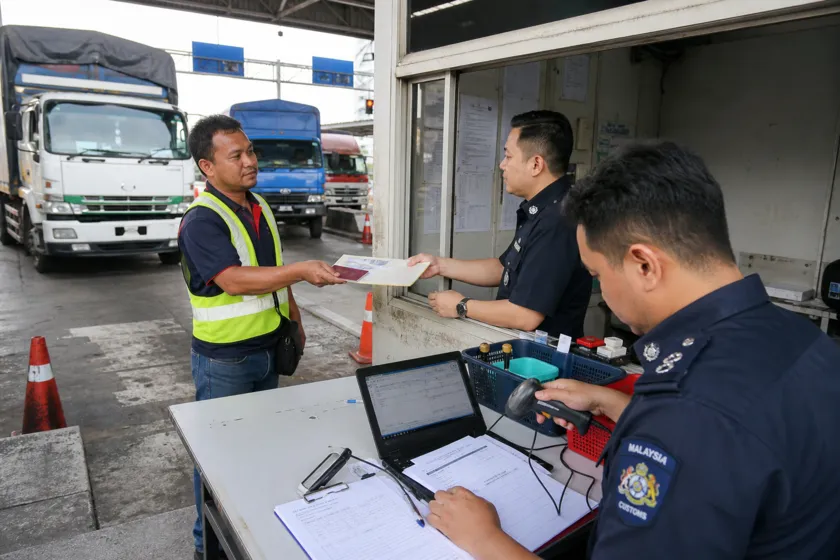
Simplified customs and cross-border trade facilitation are becoming central themes for Malaysia’s logistics ecosystem. Multiple sources describe how verified customs-based datasets translate border paperwork into structured information that firms can actually use. Malaysia trade data can be compiled from customs declarations, shipping manifests, and bill of lading records, capturing each import and export transaction crossing Malaysia’s borders. The fields include exporter and importer names, HS code, product description, shipment value, port of loading and discharge, and origin and destination countries. Malaysia import data sources also describe customs-based details such as date, HS code descriptions, gross and net weight, total value in USD, origin country, and even customs duties paid, which supports more consistent compliance planning.
Trade statistics underline the scale and variability that border agencies and traders must manage. In CEIC’s Malaysia trade series, domestic exports (FOB) were reported at 68,925.396 MYR million in Nov 2018, down from 75,533.235 MYR million in Oct 2018. CEIC also breaks out exports handled at Singapore, reported at 15,433.385 MYR million in Oct 2018, and exports not handled at Singapore, reported at 80,943.452 MYR million in Oct 2018. On the import side, imports (CIF) handled at Singapore were reported at 16,395.238 MYR million in Oct 2018. These splits matter operationally because they imply different routing, documentation paths, and coordination requirements across gateways.
What “Simplified Customs” Looks Like in Day-to-Day Trade Operations
In practice, simplification means fewer manual steps and clearer decision-making for shippers, forwarders, and brokers. A Malaysia freight and logistics market source explicitly points to “simplified customs windows” as a regulatory move that can ease border friction and cost pressures. The same source frames this shift within a wider push for network upgrades and service expectations, noting that leading platforms ship 95% of orders within 24 hours and that free-delivery preferences among 64.8% of internet users are reshaping operations. As shipments get more time-sensitive, customs brokerage work described in logistics market segmentation—import/export documentation, regulatory compliance and clearance, tariff consultancy, and trade facilitation support—becomes more dependent on clean, standardized data and predictable processing pathways.
Infrastructure and investment signals also connect to border performance because they change volumes, lane choices, and the need for faster clearance. One market source expects the Malaysia freight and logistics market to grow from USD 29.70 billion in 2025 to USD 31.23 billion in 2026, and forecasts USD 40.11 billion by 2031, at a 5.14% CAGR over 2026–2031. The same source states foreign direct investment reached MYR 378.5 billion (USD 82.3 billion) in 2024, creating 207,000 jobs, and it links growing demand to cross-border forwarding and value-added distribution. Another source says the Malaysian government allocated approximately MYR 10.5 billion in 2024 to upgrade road, rail, and port facilities, aligning with a goal to improve logistics efficiency and connectivity.
For companies, Malaysia Cross-Border Customs Reform is as much about execution as it is about policy intent. Verified shipment-level records and HS code-based analysis are repeatedly positioned as practical tools for planning and reducing risk. Trade data services highlight that files can be pre-formatted for Excel, Power BI, Tableau, or similar tools, which helps teams move from paperwork to workflows and exception handling. Logistics market descriptions also emphasize bonded warehousing and customs brokerage as core service lines, which are directly affected by how quickly documents can be validated and how consistently product classification and shipment attributes are recorded. The result is a clearer path to smoother crossings: data discipline, standardized clearance steps, and better-connected transport nodes.
What information is typically included in Malaysia’s customs-based trade data?
What do the CEIC trade statistics say about Malaysia’s exports in late 2018?
Which policy-style change is cited as easing border friction in Malaysia?
How does time-sensitive e-commerce relate to customs and clearance work?
How is Malaysia’s cross-border customs reform topic connected to investment and infrastructure activity?