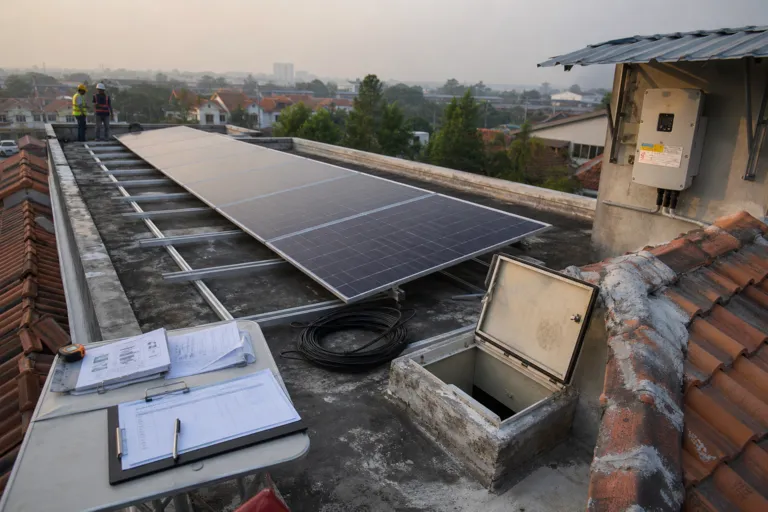
Malaysia rooftop solar leasing is moving from a niche idea into a structured set of programmes that let property owners participate without buying panels themselves. One model now highlighted in market commentary is a scheme where homeowners lease rooftop space to specialised developers or aggregators, who then generate and sell electricity within the distribution network. This approach targets a real gap in adoption: the Malaysian Photovoltaic and Sustainable Energy Industry Association (MPSEA) has said residential rooftop solar has been installed on only about 2% of Malaysia’s estimated five million landed homes. The leasing concept reframes roofs as energy assets, but the impact still needs time to prove out at scale.
The policy timeline also matters because rooftop economics depend on programme design. After NEM 3.0 concluded in June 2025, Solar ATAP is set to be released in January 2026, with guidelines still pending at the time of reporting. Official and market disclosures suggest Solar ATAP will support long-term sustainability through a market-based export rate, an uncapped development quota, and expanded system size limits to match up to 100% of a host’s maximum demand. These design signals are closely watched because Malaysia’s rooftop growth is unevenly visible in public data and often reported with a lag.
CREAM: Aggregation Turns Neighborhood Roofs Into Supply
A more explicit leasing-and-aggregation pathway is the Community Renewable Energy Aggregation Mechanism (CREAM). Under guidelines announced in March 2025, energy companies can install and manage PV systems on aggregated residential rooftops, while homeowners receive payment for leasing their space. The same guidelines state that the electricity generated from these aggregated rooftops can be sold directly to consumers within a 5-kilometer radius, creating decentralized energy hubs. Industry voices caution that rooftop rental income is likely to be “modest,” because developers still need to recover capital investment, generate returns, and fund operations and maintenance over the system’s lifespan. Still, CREAM is positioned as a practical option for households deterred by high upfront costs.
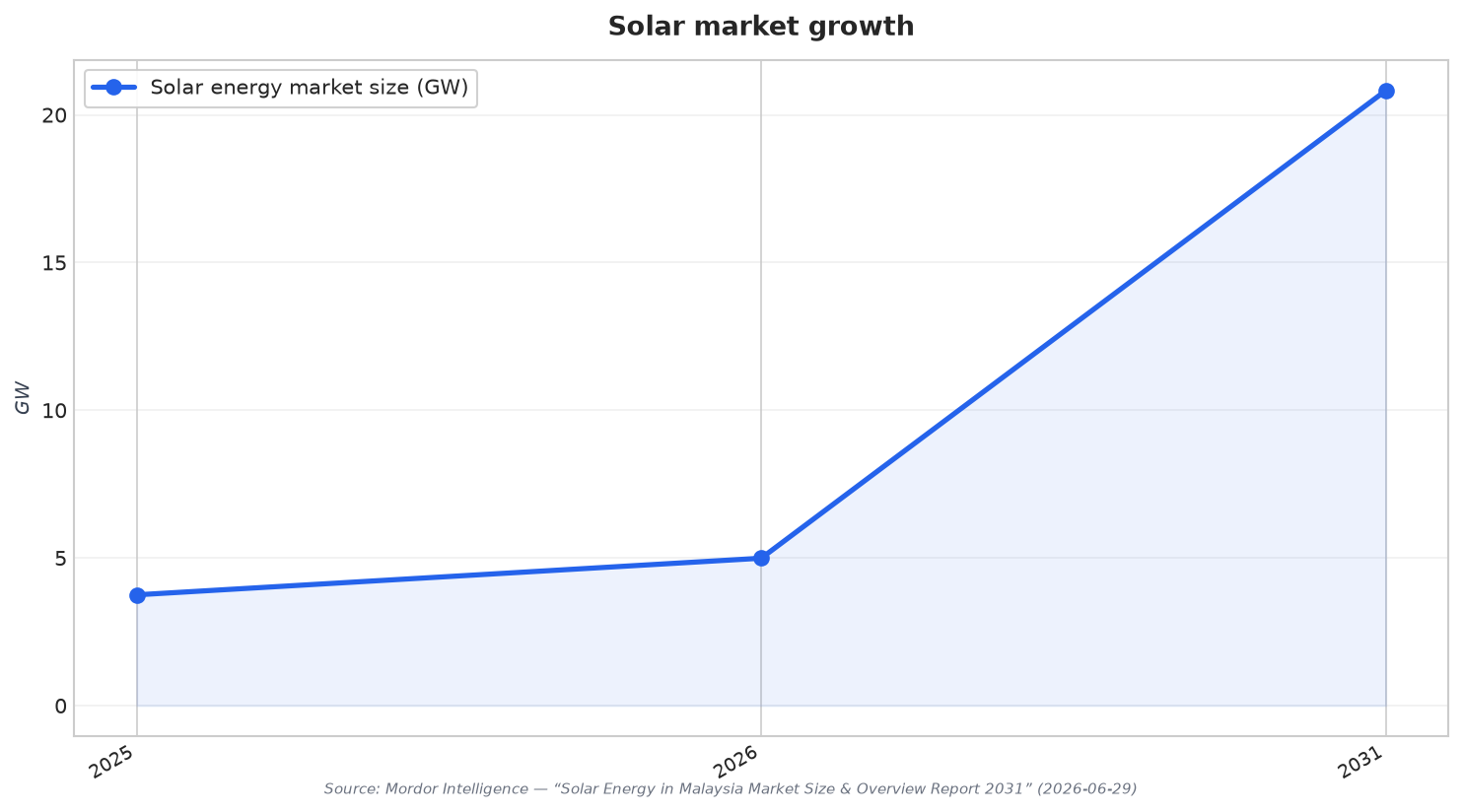
These new models are emerging alongside a broader market expansion that can influence financing appetite and developer pipelines. Mordor Intelligence projects the Malaysia solar energy market to grow from 3.75 GW in 2025 to 4.99 GW in 2026, reaching 20.82 GW by 2031 at a 33.1% CAGR over 2026–2031, based on its proprietary estimation framework. In another view, MarkWide Research estimates the Malaysia solar energy market at $3.8 billion in 2026, forecasting $12.55 billion by 2035 at a 14.20% CAGR. For rooftops specifically, the Energy Commission (ST) reported that as of July 2025, rooftop solar capacity stood at 1.72 GW, accounting for 40% of Malaysia’s total installed solar capacity.
For homes and SMEs, the near-term question is less about whether rooftop solar is possible, and more about which participation route is simplest. NEM schemes have been refined over time, including a shift from an initially unattractive buy-back rate to a true net metering approach with one-for-one offsetting. Now, leasing and aggregation add a parallel lane that can work even when a homeowner does not want to invest directly. Corporate participants are also exploring the concept: The Star reported that Time dotCom, through Time Energy, is exploring CREAM participation and is looking to leverage rooftops near AIMS’ Cyberjaya data centre for leased solar installations, with generated power aggregated and supplied to AIMS.
What does rooftop solar leasing mean in Malaysia today?
How does the CREAM aggregation model work for households?
How much rooftop solar capacity has Malaysia installed so far?
What is changing after NEM 3.0 ends?
Is Malaysia rooftop solar leasing likely to generate large income for homeowners?